

AI adoption can look like progress before the business actually feels better.
People are using the tools. Drafts are faster. Meeting notes are cleaner. Research gets summarized. Ideas appear more quickly. Analysis that once took hours can start in minutes.
That matters. Nobody should dismiss the productivity gain.
But a business does not improve because a paragraph gets written faster.
It improves when the work that serves customers, manages risk, makes decisions, and delivers outcomes gets better.
That is where many organizations are about to feel the gap.
They may have more AI activity than ever and still be asking familiar questions.
- Why are handoffs still messy?
- Why are requests still incomplete?
- Why are decisions still inconsistent?
- Why are customers still waiting?
- Why does the business not feel as different as the tool demos promised?
That is the process question AI cannot skip.
AI is already entering the way work gets done
Most AI conversations begin with what the technology can do. That is understandable. The capabilities are impressive, and teams need room to experiment.
But once AI starts helping with, shaping, or performing parts of the work, the question changes.
Who created the first version? Who reviewed it? What assumptions were introduced? What source material was used? What decision did the output influence? Where did the work move faster? Where did risk increase? Who remains accountable for the result?
Those are not just AI questions. They are process questions.
That is the issue behind The AI Conversation Is Missing the Process Question. The important question is not only what AI can do. It is what happens to the work when AI becomes part of it.
This does not mean every AI use case requires a major redesign. It means AI changes the work around it. If the work matters, the process question matters too.
AI activity is not the same as business value
AI activity is easy to see.
More people are using tools. More drafts are created. More notes are summarized. More recommendations are generated. More work appears to move faster.
That can be useful. It can also be misleading.
A service team may use AI to summarize incoming customer requests faster. That helps. But if requests are still incomplete, routing is unclear, and no one owns the handoff, the customer may not experience a better process.
The tool may be working.
The work may still need attention.
That is the gap behind If AI Is Succeeding, Why Isn’t the Business Moving? Task-level AI wins can be real, but business performance improves when end-to-end work improves.
For leaders and teams, this is the practical test: not whether AI is being used, but whether AI is helping improve the work that produces the result.
AI inherits the process around it
AI does not enter a clean room.
It enters the work people already have: the handoffs, delays, roles, approvals, exceptions, workarounds, customer expectations, systems, and measures that shape how performance actually happens.
If that work is clear, measured, and well designed, AI has a better chance of accelerating something useful.
If that work is unclear, inconsistent, or poorly owned, AI may simply help people move faster inside the same confusion.
That is the risk behind AI Doesn’t Leave Your Operational Problems Behind. It Brings Them With It. Broken handoffs do not disappear because AI is introduced. Unclear ownership does not resolve itself. Inconsistent decisions do not become consistent on their own.
The technology may be new. The operating questions are not.
Where is work breaking down? Who owns the decision? What has to be validated? What should be measured? What changes if the AI output is wrong, incomplete, or used in the wrong place?
Those are not side questions. They determine whether AI becomes useful in the real work of the business.
They also lead to a harder maturity question: is the organization building enough process capability around the AI it is adopting?
AI value rises with process maturity
AI can help at every level of process maturity.
At the earliest level, people use AI because it is available. They summarize notes, draft procedures, organize input, prepare improvement ideas, or turn rough descriptions into cleaner language. The work looks better. It may even move faster.
But polish can be deceptive.
A cleaner process description is not necessarily a better understanding of the process. A faster recommendation is not necessarily a better decision. A well-written improvement idea is not necessarily ready for implementation.
That is why BPMInstitute.org’s Process + AI Maturity Framework matters. It gives organizations a practical way to see the path from ad hoc experimentation to managed, standardized, predictable, and continuously improving AI-connected work.
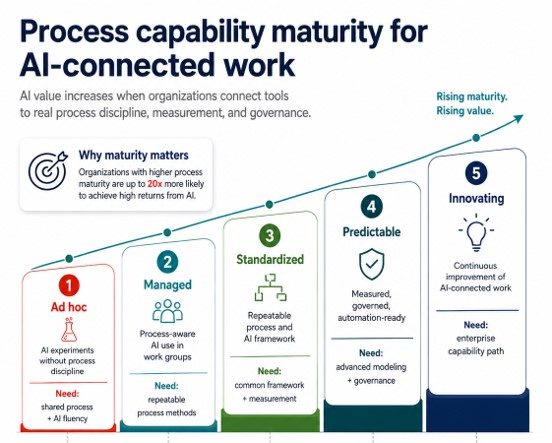
Process + AI maturity increases as AI use connects to stronger process discipline, measurement, governance, and improvement
The point is not to make maturity sound complicated. The point is to make AI value more honest.
At low maturity, AI may help individuals finish tasks faster.
At higher maturity, AI can support shared methods, clearer handoffs, stronger analysis, consistent review, useful measures, governance, and disciplined improvement.
That is the difference between AI as a shortcut and AI as a capability multiplier.
A shortcut helps someone finish a task faster.
A capability multiplier helps the organization improve how work is understood, designed, managed, and improved.
Explore the full Process + AI Maturity Framework.
Process management did not become less important
Once you see AI through that maturity lens, process management no longer looks like a separate discipline waiting off to the side.
It looks like the discipline that helps AI move from activity to value.
That is why one risky assumption in the AI conversation deserves to be challenged: the idea that process work can wait while AI moves ahead.
The stronger view is the opposite.
As AI moves deeper into real work, process management becomes more important.
AI does not compete with process management. It increases the need for process capability. Organizations need to understand what is changing, where AI belongs, what people still own, which decisions require judgment, which controls matter, and how improvement will be measured.
That is process work.
This is the case made in AI Didn’t Replace Process Management. It Raised the Stakes. Organizations serious about AI need more than tool access. They need process capability that helps connect AI activity to business results.
AI can help teams move faster. Process management helps teams know where faster movement matters.
The capability question is bigger than tool use
The next challenge is not only whether people can use AI.
It is whether teams can use AI to improve work.
That requires more than prompt fluency. It requires the ability to define the problem, frame the work, clarify handoffs, understand the decision, identify the risk, choose the right output, and review the result with judgment.
That is why process professionals have an important advantage.
They are trained to look beyond the task. They understand scope, current state, roles, inputs, outputs, systems, exceptions, measures, validation, and next steps.
When they bring that discipline to AI, the tool becomes more useful.
That is the point of The Process Professional’s AI Advantage: in process work, the advantage rarely belongs to the person who gets the fastest answer. It belongs to the person who knows what the work requires.
For leaders, this shifts the capability question.
The goal is not simply to help people use AI. The goal is to help teams improve processes with AI.
That means helping people connect AI to better decisions, clearer handoffs, less rework, stronger recommendations, better customer experience, and measurable improvement.
The question to ask now
AI will keep getting more capable. It will keep moving into the tools, systems, workflows, decisions, and everyday moments where work gets done.
That is not a reason to put process thinking on hold.
It is the reason process thinking has to move closer to the center of the AI conversation.
The first wave of adoption has made AI activity visible. The next wave has to make business improvement visible.
That will not be measured only by how many people use AI, how many drafts it creates, or how quickly teams can produce summaries, recommendations, and reports.
It will be measured by what changes in the work itself.
Are handoffs clearer? Are decisions better? Is rework reduced? Are customers experiencing a better process? Are risks easier to see? Are teams learning how human work, system work, and AI-supported work perform together?
Without process capability, AI may make work faster without making the business better.
That is the practical challenge now.
For leaders, the question is not only:
Where can we use AI?
For process professionals, it is not only:
How can AI make my work faster?
For teams, it is not only:
What can this tool produce?
The better question is:
What work should AI help us improve – and how will we know it got better?
That is the process question AI cannot skip.
Editor’s Note: AI and BPM are already coming together in the way organizations understand, manage, and improve work. The next step is to assess where your organization is today.
BPMInstitute.org’s assessments are designed to help leaders and teams gauge readiness, identify capability gaps, and clarify where stronger process discipline may be needed before AI-supported work can produce measurable business value.
Use the assessments to ask a practical question:
Are we ready to connect AI activity to better process outcomes?
Take the BPM Skills Self-Assessment and/or the AI for Process Self-Assessment to gauge your readiness.