
If AI Is Succeeding, Why Isn’t the Business Moving?

Author(s)

Editor & Founder, BPMInstitute.org, BAInstitute.org and DBIZInstitute.org
With over 25 years experience building and creating professional communities, Gregg Rock is recognized as an industry leader in professional training and education vital to helping enterprise organizations support their transformation initiatives. His work has been recognized in the Wall Street Journal, Fortune Magazine, Financial Times, CIO Magazine, and New...

AI activity can become visible across the organization.

Teams are using AI to write, summarize, research, analyze, code, document, generate ideas, answer questions, prepare materials, and automate parts of their daily work.

Those individual gains can be useful.

But they do not always move business performance in a visible or measurable way.

Task-level AI wins are valuable, but they should not be confused with broader business performance improvement.

A team may improve a task while the larger process remains slow. An employee may move faster while the handoff to the next team still breaks down. A department may produce more output while the measures leaders care about, such as customer satisfaction, cycle time, cost to serve, or operating performance, do not improve in the same way.

That raises an important question:

If AI is succeeding, why isn’t the business moving?
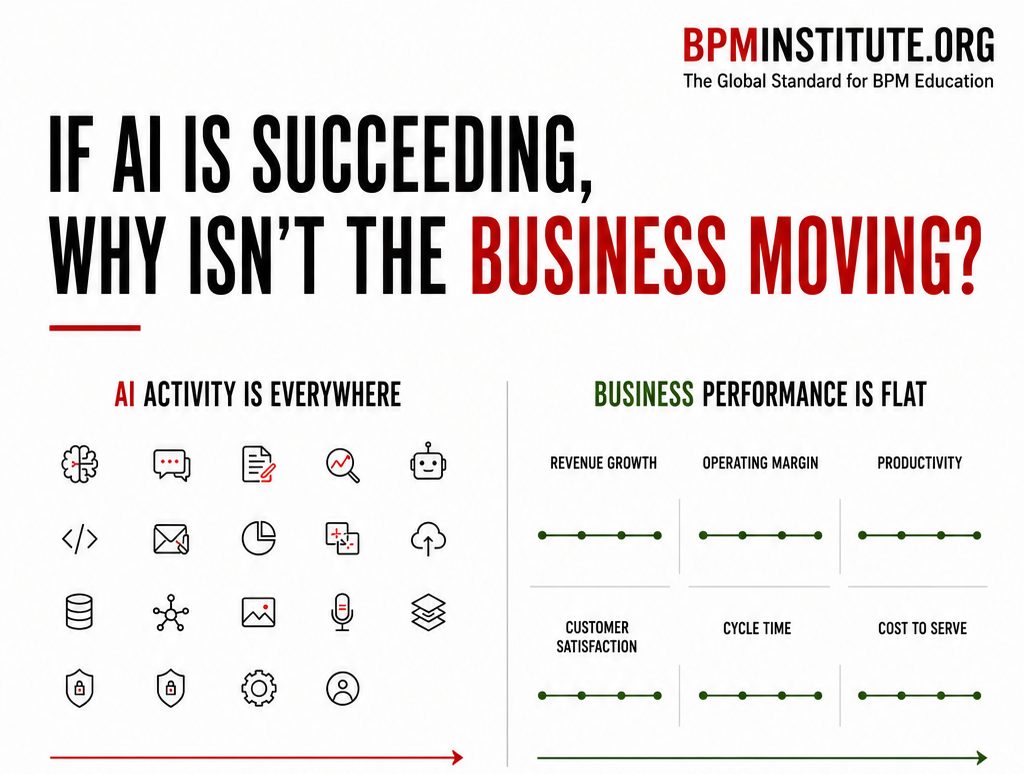
AI can improve individual tasks, but business performance improves when end-to-end work improves. Process capability connects isolated AI success to measurable business performance.

Download the PDF — If AI Is Succeeding, Why Isn’t the Business Moving?

AI can improve individual tasks

Many AI use cases begin at the task level.

That is understandable. Task-level improvements are easier to see, easier to test, and easier for individuals to adopt.

A person uses AI to draft a document faster. A team uses it to summarize feedback. An analyst uses it to compare information. A manager uses it to prepare for a meeting. A process professional uses it to support discovery or organize findings.

These are useful applications.

But task improvement is not the same as process improvement.

A faster task only improves the business if it contributes to better end-to-end work.

Business performance improves when end-to-end work improves

Business performance depends on more than isolated tasks.

It depends on how work moves across people, teams, systems, decisions, and handoffs. It depends on whether the right information reaches the right person at the right time. It depends on whether ownership is clear, decisions are consistent, delays are reduced, and customers receive value without unnecessary friction.

That is why AI success can remain isolated.

A task may improve, but the process around it may not. A team may work faster, but the business outcome may stay flat. AI may create more activity, but the customer or internal stakeholder may not experience meaningful improvement.

Meaningful business improvement usually depends on improving how end-to-end work performs, not just how individual tasks are completed.

To move the business, organizations need to connect AI use to end-to-end process performance.

The missing link is process capability

Process capability can be the bridge between isolated AI successes and measurable business performance.

It helps teams understand where AI should be applied, what problem it should support, and how the results should be evaluated.

Without process capability, AI efforts can scatter across individual tasks. Some may be helpful. Some may save time. Some may produce better drafts, summaries, or analysis.

But the organization may still struggle to answer the larger question:

What changed in the way the business performs?

Process capability helps connect AI activity to the work that matters most.

Look beyond the task

When evaluating AI success, leaders should look beyond whether individual tasks are faster.

They should ask:

Did the process improve?
Did the handoff become clearer?
Did the decision move faster or become more consistent?
Did rework decrease?
Did the customer experience improve?
Did cycle time change?
Did the cost to serve improve?
Did the business outcome move?

These questions are not meant to slow AI adoption.

They are meant to make AI adoption more valuable.

AI success needs a process view

AI can help improve how people work, but business performance usually depends on how the whole process works.

That means leaders and teams need a process view.

They need to understand the current state of the work, the desired outcome, the people involved, the decisions required, the risks that could slow progress, and the metrics that matter.

Then AI can be applied with purpose.

Instead of asking only, “Where can AI help someone complete a task faster?” the organization can ask, “Where can AI help improve the way work flows from beginning to end?”

That shift is important.

It helps move AI from a collection of individual successes toward a more disciplined approach to business improvement.

Connect AI success to business performance

If AI activity is increasing but business performance is not improving, the issue may not be AI capability.

The issue may be a gap in process capability.

The organization may need a clearer view of how work flows, where performance is stuck, and where AI can support meaningful improvement.

AI can improve tasks.

Businesses improve when end-to-end work improves.

Process capability helps connect the two.

BPMInstitute.org helps professionals and teams build the process capability needed to connect AI success to business performance. Call (855) 304-8444 to start the conversation.

Similar Resources

Turning AI Activity into Process Improvement

Turning AI Activity into Process Improvement

Author(s):

Editor & Founder, BPMInstitute.org, BAInstitute.org and DBIZInstitute.org

Many organizations are moving quickly to give employees access to AI tools. That access matters. But access alone does not create business value. Once teams begin using AI, activity can increase quickly. People may use it to summarize information, draft documentation,...

When a Specialized Training Request Lands on Your Desk

When a Specialized Training Request Lands on Your Desk

Author(s):

Editor & Founder, BPMInstitute.org, BAInstitute.org and DBIZInstitute.org

A specialized training request can sound simple at first. A team needs training. A leader has a goal. A group of employees needs to build skills, align around shared methods, support current process work, or strengthen the way they work. But for the Talent &...

Is Your Process Recommendation Ready for the Room?

Is Your Process Recommendation Ready for the Room?

Author(s):

Editor & Founder, BPMInstitute.org, BAInstitute.org and DBIZInstitute.org

A process recommendation can be clear to you and still fail in the room. That is one of the harder lessons in process work. You may understand the issue. You may have done the analysis. You may know why the recommendation matters and what should happen next. But the...

Featured Certificate: BPM Specialist

Everyone starts here.

You're looking for a way to improve your process improvement skills, but you're not sure where to start.

Earning your Business Process Management Specialist (BPMS) Certificate will give you the competitive advantage you need in today's world. Our courses help you deliver faster and makes projects easier.

Your skills will include building hierarchical process models, using tools to analyze and assess process performance, defining critical process metrics, using best practice principles to redesign processes, developing process improvement project plans, building a center of excellence, and establishing process governance.

The BPMS Certificate is the perfect way to show employers that you are serious about business process management. With in-depth knowledge of process improvement and management, you'll be able to take your business career to the next level.

Learn more about the BPM Specialist Certificate

Courses

  •  


Certificates

  • Business Process Management Specialist
  • Earning your Business Process Management Specialist (BPMS) Certificate will provide you with a distinct competitive advantage in today’s rapidly evolving business landscape. With in-depth knowledge of process improvement and management, you’ll be able to take your business career to the next level.
  • BPM Professional Certificate
    Business Process Management Professional
  • Earning your Business Process Management Professional (BPMP) Certificate will elevate your expertise and professional standing in the field of business process management. Our BPMP Certificate is a tangible symbol of your achievement, demonstrating your in-depth knowledge of process improvement and management.

Certification

BPM Certification

  • Make the most of your hard-earned skills. Earn the respect of your peers and superiors with Business Process Management Certification from the industry's top BPM educational organization.

Courses


Certificates

  • Operational Excellence Specialist
  • Earning your Operational Excellence Specialist Certificate will provide you with a distinct advantage in driving organizational excellence and achieving sustainable improvements in performance.


OpEx Professional Certificate

  • Operational Excellence Professional
  • Earn your Operational Excellence Professional Certificate and gain a competitive edge in driving organizational excellence and achieving sustainable improvements in performance.

Courses

Certificate

  • Agile BPM Specialist
  • Earn your Agile BPM Specialist Certificate and gain a competitive edge in driving business process management (BPM) with agile methodologies. You’ll gain a strong understanding of how to apply agile principles and concepts to business process management initiatives.
 

Business Architecture


Certificates

  • Business Architecture Specialist
  • The Business Architecture Specialist (BAIS) Certificate is proof that you’ve begun your business architecture journey by committing to the industry’s most meaningful and credible business architecture training program.

  • Business Architecture Professional
  • When you earn your Business Architecture Professional (BAIP) Certificate, you will be able to design and implement a governance structure for your organization, develop and optimize business processes, and manage business information effectively.

BA CertificationCertification

  • Make the most of your hard-earned skills. Earn the respect of your peers and superiors with Business Architecture Certification from the industry's top BPM educational organization.

Courses


Certificates

  • Digital Transformation Specialist
  • Earning your Digital Transformation Specialist Certificate will provide you with a distinct advantage in today’s rapidly evolving business landscape. 


  • Digital Transformation Professional
  • The Digital Transformation Professional Certificate is the first program in the industry to cover all the key pillars of Digital Transformation holistically with practical recommendations and exercises.

Courses

Certificate

Courses

Certificate

  • Process Automation Specialist Certificate
  • By completing the Process Automation Specialist Certificate, you will not only enhance your modeling skills but also demonstrate a serious commitment to advancing business process management within your organization.

Courses

Certificate

  • Agile Business Analysis Specialist
  • Earning your Agile Business Analysis Specialist Certificate will provide you with a distinct advantage in the world of agile software development.