

AI does not have to become autonomous before it changes how process work gets done.
For most organizations, the shift starts quietly.
A process analyst uses AI to summarize discovery notes.
A manager uses AI to draft a procedure.
A team uses AI to organize customer feedback.
A project lead uses AI to prepare an improvement brief.
Someone asks AI to review a process description, suggest gaps, or turn rough notes into a clearer explanation of the work.
None of this may feel like a major transformation.
It may simply feel like help.
But that is exactly why organizations need to pay attention. AI is already showing up inside the everyday work of understanding, documenting, analyzing, communicating, and improving processes.
The question is not just whether AI can help with that work.
It can.
The better question is whether the organization has enough process capability to use that help well.
That is where many teams will find the real gap.
This is where weak process discipline becomes hard to hide. As AI starts summarizing, analyzing, recommending, and redesigning work, the quality of the process underneath matters more, not less.
Davenport and Redman make the executive challenge explicit in Harvard Business Review: “Process needs to lie at the core. After all, it’s through processes that organizations deliver value.” They go further, arguing that it is time for senior managers to “put process back on their radar screens.” That is the point for the AI era: organizations that want value from AI have to take the work itself seriously again.
AI can make weak process work faster. It can make incomplete thinking sound more polished. It can turn messy notes into a clean summary without knowing whether the summary is accurate. It can suggest improvements without understanding the politics, constraints, exceptions, customer impact, compliance requirements, or operational reality behind the process.
In other words, AI can improve the appearance of process work before it improves the quality of process work.
That is why maturity matters.
McKinsey’s operations research makes the same point in process language. Its study says AI’s impact comes not from “experimentation alone” but from “integration into core operational processes.” In one company example, McKinsey writes that “careful mapping of processes from end to end revealed needless complexity and delay.” That is the maturity lesson in plain view: organizations do not get durable AI value by layering technology onto unclear work. They get it by clarifying, simplifying, and redesigning the processes AI is meant to support.
AI Value Depends on Process Maturity
The maturity path below shows how AI value increases as process capability matures – from ad hoc experimentation to managed, standardized, predictable, and continuously improving AI-connected work.
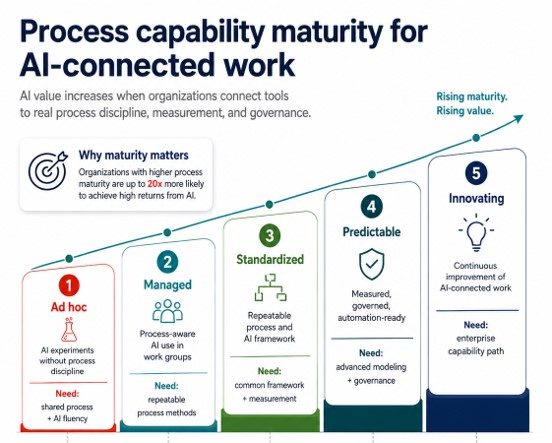
AI can support process work at every level, but value increases when AI is connected to stronger process discipline, measurement, governance, and improvement.
Download the PDF — Process + AI Maturity Framework
At the earliest level, AI use is often ad hoc. Individuals experiment. They try prompts, generate summaries, draft documents, and create recommendations. Some of the work may be useful, but the organization does not yet have shared standards for what good AI-supported process work looks like.
At this level, AI creates activity. It may even create speed. But without process discipline, it does not reliably create business value.
The next level is more managed. Teams begin using AI with greater intention. It supports discovery, organizes input, clarifies current-state issues, and helps people communicate process problems more clearly. AI is no longer just a personal shortcut. It becomes part of how a team understands and improves work.
But even here, the value depends on method. Who reviews the output? What standard defines quality? What business context must be preserved? What assumptions need to be checked?
As process capability becomes more standardized, AI can support more consistent work across teams. It can help apply common templates, compare process information, draft documentation, identify recurring issues, and support a more repeatable way of analyzing work.
This is where AI begins to move from individual productivity to organizational capability.
At a more predictable level, AI-supported process work can be connected to measures, controls, decisions, exceptions, governance, and automation readiness. The organization is no longer just using AI to produce better documents. It is using AI within a process discipline that can be measured, managed, and improved.
At the highest level, AI becomes part of continuous process innovation. The organization is not simply asking people to use AI more often. It is learning how human work, system work, and AI-supported work perform together over time.
The pattern is simple:
AI can help at every maturity level, but it creates more value when it is connected to stronger process capability.
That is the practical lesson for organizations right now.
AI Can Be a Shortcut or a Capability Multiplier
A team with weak process discipline may use AI to produce faster summaries, cleaner documentation, and more polished recommendations. But if the team does not understand the process, validate the output, measure the impact, or govern how the results are used, the value will be limited.
A team with stronger process capability can use AI differently. It can connect AI to real methods, better discovery, clearer documentation, stronger analysis, better measurement, and more disciplined improvement.
That is the difference between AI as a shortcut and AI as a capability multiplier.
A shortcut helps someone finish a task faster.
A capability multiplier helps the organization improve how work is understood, designed, managed, and improved.
Process Professionals Still Need to Know What Good Looks Like
For process professionals, this is the immediate opportunity.
AI can help reduce friction in process work. It can help move from blank page to first draft. It can organize messy input. It can translate technical process language into clearer business language. It can help identify patterns. It can help teams communicate what they are learning.
But process professionals still have to know what good looks like.
They have to understand the work.
They have to test the output against reality.
They have to preserve context.
They have to notice exceptions.
They have to challenge assumptions.
They have to connect process work to business outcomes.
AI can assist process work.
Process capability determines whether that assistance becomes real value.
Start by Looking at Where AI Is Already Touching Process Work
This is why the starting point for many organizations is not a giant AI transformation program. It is a more disciplined look at where AI is already touching process work.
Where are people using AI today?
Are they using it for discovery, documentation, analysis, improvement, communication, or recommendations?
Are they following shared methods?
Who reviews the output?
What standards define quality?
What assumptions need to be checked?
What process measures tell us whether the work improved?
What governance is needed as AI touches more important work?
These questions create a practical bridge between today’s AI use and tomorrow’s AI-connected work.
They also help organizations avoid two mistakes.
The first mistake is pretending AI is only a future issue. It is not. AI is already entering process work through everyday tasks.
The second mistake is pretending AI maturity is the same thing as process maturity. It is not. A team can use advanced tools while still having immature process discipline.
That distinction matters.
Process Capability Is the Practical Doorway Into AI and BPM
The organizations that benefit most from AI will not simply be the ones that use it the most. They will be the ones that mature the process capability around it.
They will know where AI helps.
They will know where human judgment is required.
They will know how to validate output.
They will know how to connect AI-supported work to real process improvement.
That is the practical doorway into AI and BPM.
Before organizations redesign entire workflows, govern AI agents, or manage human-and-AI performance at scale, they need to understand the AI-supported process work already happening around them.
Because the future is not arriving all at once.
It is showing up first in the drafts, summaries, analyses, recommendations, and improvement conversations that shape how work gets understood.
And that is where process capability needs to show up, too.
Understanding What AI Can Do Is Only the Beginning.
Clarity is the difference between keeping up with the AI conversation and knowing what to make of it. The more of the picture you see, the easier it is to separate what matters from what doesn’t, speak about it with confidence, and make better judgments about the work ahead. This article is one piece of that picture; the others help complete it.
See How the Pieces Fit Together
How Ready Are You to Use AI in Process Work?
Get a Personalized Skills Snapshot to see where your AI-for-process capabilities are strong, where more structure would help, and what to focus on next.