
AI Doesn’t Leave Your Operational Problems Behind. It Brings Them With It.

Author(s)

Editor & Founder, BPMInstitute.org, BAInstitute.org and DBIZInstitute.org
With over 25 years experience building and creating professional communities, Gregg Rock is recognized as an industry leader in professional training and education vital to helping enterprise organizations support their transformation initiatives. His work has been recognized in the Wall Street Journal, Fortune Magazine, Financial Times, CIO Magazine, and New...

AI can change the way work gets done.

It can help teams summarize information, analyze inputs, generate drafts, identify patterns, support decisions, and move faster through parts of the work.

But AI does not automatically fix the operational problems that already exist.

Broken handoffs do not disappear because AI is introduced. Unclear ownership does not resolve itself. Inconsistent decisions do not become consistent on their own. Workarounds do not stop being workarounds simply because a new tool is added.

In many cases, AI brings those problems into the new way of working.

And when those problems are not addressed, AI can help carry them forward faster and make them more visible across the work.
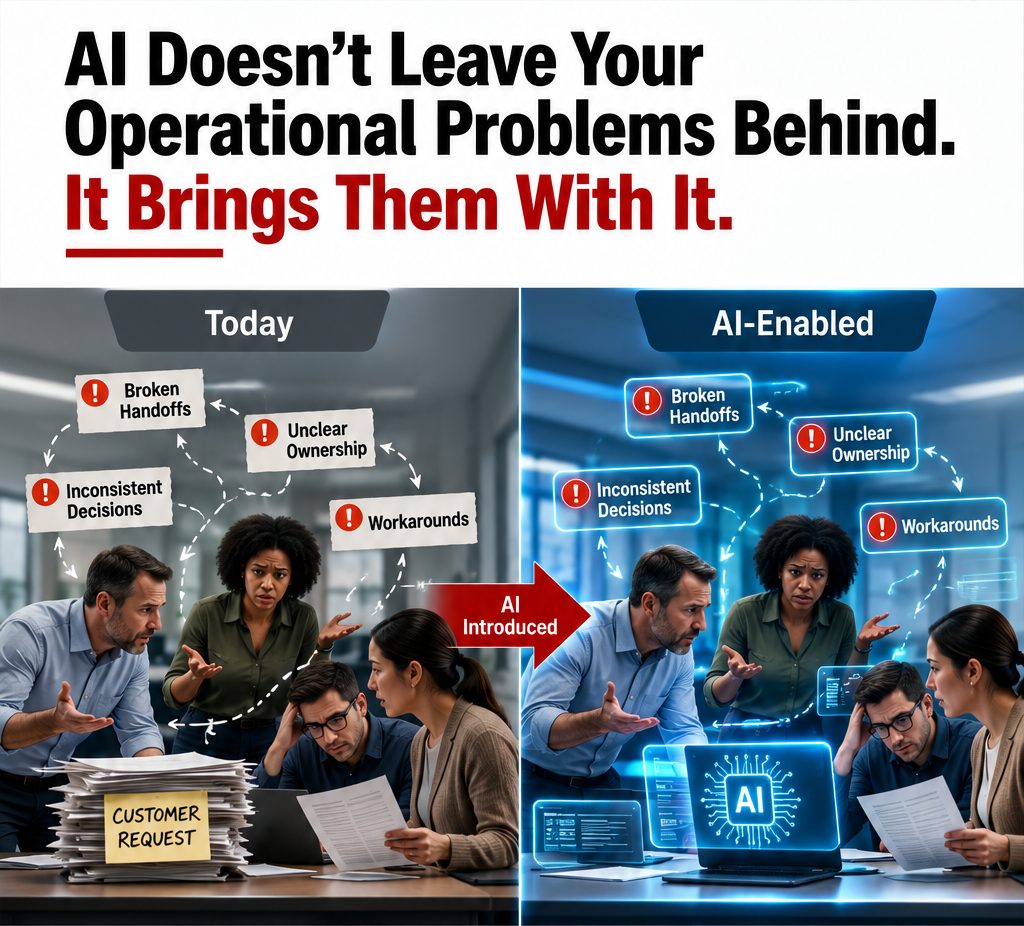
AI does not make operational problems disappear. Broken handoffs, unclear ownership, inconsistent decisions, and workarounds need process clarity before AI can improve the work.

Download the PDF — AI Doesn’t Leave Your Operational Problems Behind. It Brings Them With It.

The technology may be new. The operational problems are not.

Many operational issues existed long before AI entered the conversation.

Teams struggled with unclear responsibilities. Customers waited while requests moved between groups. Decisions stalled because ownership was uncertain. People created workarounds just to keep work moving.

AI may change the surface of the work, but it does not automatically change the process underneath it.

If the process is unclear, AI may still operate inside an unclear process. If ownership is fragmented, AI may still support work that no one fully owns. If decisions are inconsistent, AI may help produce more information without making the decision path clearer.

That is why AI adoption has to be connected to process understanding.

Broken handoffs still matter

Handoffs are a common source of delay and confusion.

When work moves from one person, team, system, or function to another, the process depends on clarity. What information moves forward? Who is responsible? What triggers the next step? What happens when something is missing?

AI can help summarize, route, organize, or analyze information around a handoff.

But if the handoff itself is broken, AI may not solve the underlying issue. It may speed up activity around the handoff without resolving the underlying handoff problem.

Before applying AI to a workflow, teams need to understand where handoffs occur and whether they are working as intended.

Unclear ownership becomes harder to ignore

AI-enabled work still needs ownership.

Someone has to decide what problem is being addressed. Someone has to validate outputs. Someone has to determine whether a recommendation is appropriate. Someone has to act on the next step.

When ownership is unclear, AI can create more activity without creating more accountability.

That can make work feel more advanced while leaving the same basic question unresolved:

Who owns the outcome?

Process management helps clarify ownership before AI is layered into the work. It gives teams a way to see who is involved, what role they play, and where responsibility needs to be clearer.

Inconsistent decisions can repeat faster

AI can support decision-making, but it does not automatically create decision discipline.

If different teams make decisions in different ways, use different criteria, or rely on inconsistent information, AI may reflect or reinforce that inconsistency, depending on how it is designed, governed, and used.

The result can be faster movement without better alignment.

That is why teams need to understand the decision points inside a process. They need to know where decisions are made, who makes them, what information is required, and what criteria should guide the outcome.

AI can help prepare decision-makers, but process clarity helps make the decision itself more consistent.

Workarounds do not become strategy

Workarounds often exist because people are trying to keep work moving despite process problems.

They may help in the short term, but they can also hide deeper issues. A workaround may point to unclear requirements, missing information, system limitations, approval delays, poor handoffs, or responsibilities that are not well defined.

AI can make it easier to navigate around friction.

That can be useful in the short term, but it should not be mistaken for process improvement.

If AI is applied without understanding the workarounds people depend on, the organization may miss important signals about where the process needs to improve.

AI raises the stakes for process management

AI can be valuable when it is applied to work that is understood clearly enough to improve.

That is where process management becomes especially important.

Process management helps teams see how workflows operate, where problems occur, where ownership is unclear, where decisions matter, and where improvement is needed.

Without that view, AI may move operational issues forward instead of resolving them.

Used well, AI may also help teams see operational patterns more clearly, but those insights still need process ownership, judgment, and action.

With that process view, AI can be applied more thoughtfully. Teams can use it to support discovery, analysis, communication, recommendations, and decision-making in ways that are tied to actual process improvement.

Start with the operational problems AI will inherit

Before asking how AI can improve the work, ask what problems AI will inherit.

Where are handoffs broken?
Where is ownership unclear?
Where are decisions inconsistent?
Where are people relying on workarounds?
Where is the process already creating delay, confusion, or rework?

Those are the places where process management matters most.

AI does not leave operational problems behind. It brings them into the next way of working.

Organizations are more likely to get value from AI when they understand the work before they try to transform it.

BPMInstitute.org helps professionals and teams build the process capability needed to identify operational problems, improve work, and apply AI with greater clarity. Explore BPMInstitute.org training.


Similar Resources

Turning AI Activity into Process Improvement

Turning AI Activity into Process Improvement

Author(s):

Editor & Founder, BPMInstitute.org, BAInstitute.org and DBIZInstitute.org

Many organizations are moving quickly to give employees access to AI tools. That access matters. But access alone does not create business value. Once teams begin using AI, activity can increase quickly. People may use it to summarize information, draft documentation,...

When a Specialized Training Request Lands on Your Desk

When a Specialized Training Request Lands on Your Desk

Author(s):

Editor & Founder, BPMInstitute.org, BAInstitute.org and DBIZInstitute.org

A specialized training request can sound simple at first. A team needs training. A leader has a goal. A group of employees needs to build skills, align around shared methods, support current process work, or strengthen the way they work. But for the Talent &...

Is Your Process Recommendation Ready for the Room?

Is Your Process Recommendation Ready for the Room?

Author(s):

Editor & Founder, BPMInstitute.org, BAInstitute.org and DBIZInstitute.org

A process recommendation can be clear to you and still fail in the room. That is one of the harder lessons in process work. You may understand the issue. You may have done the analysis. You may know why the recommendation matters and what should happen next. But the...

Featured Certificate: BPM Specialist

Everyone starts here.

You're looking for a way to improve your process improvement skills, but you're not sure where to start.

Earning your Business Process Management Specialist (BPMS) Certificate will give you the competitive advantage you need in today's world. Our courses help you deliver faster and makes projects easier.

Your skills will include building hierarchical process models, using tools to analyze and assess process performance, defining critical process metrics, using best practice principles to redesign processes, developing process improvement project plans, building a center of excellence, and establishing process governance.

The BPMS Certificate is the perfect way to show employers that you are serious about business process management. With in-depth knowledge of process improvement and management, you'll be able to take your business career to the next level.

Learn more about the BPM Specialist Certificate

Courses

  •  


Certificates

  • Business Process Management Specialist
  • Earning your Business Process Management Specialist (BPMS) Certificate will provide you with a distinct competitive advantage in today’s rapidly evolving business landscape. With in-depth knowledge of process improvement and management, you’ll be able to take your business career to the next level.
  • BPM Professional Certificate
    Business Process Management Professional
  • Earning your Business Process Management Professional (BPMP) Certificate will elevate your expertise and professional standing in the field of business process management. Our BPMP Certificate is a tangible symbol of your achievement, demonstrating your in-depth knowledge of process improvement and management.

Certification

BPM Certification

  • Make the most of your hard-earned skills. Earn the respect of your peers and superiors with Business Process Management Certification from the industry's top BPM educational organization.

Courses


Certificates

  • Operational Excellence Specialist
  • Earning your Operational Excellence Specialist Certificate will provide you with a distinct advantage in driving organizational excellence and achieving sustainable improvements in performance.


OpEx Professional Certificate

  • Operational Excellence Professional
  • Earn your Operational Excellence Professional Certificate and gain a competitive edge in driving organizational excellence and achieving sustainable improvements in performance.

Courses

Certificate

  • Agile BPM Specialist
  • Earn your Agile BPM Specialist Certificate and gain a competitive edge in driving business process management (BPM) with agile methodologies. You’ll gain a strong understanding of how to apply agile principles and concepts to business process management initiatives.
 

Business Architecture


Certificates

  • Business Architecture Specialist
  • The Business Architecture Specialist (BAIS) Certificate is proof that you’ve begun your business architecture journey by committing to the industry’s most meaningful and credible business architecture training program.

  • Business Architecture Professional
  • When you earn your Business Architecture Professional (BAIP) Certificate, you will be able to design and implement a governance structure for your organization, develop and optimize business processes, and manage business information effectively.

BA CertificationCertification

  • Make the most of your hard-earned skills. Earn the respect of your peers and superiors with Business Architecture Certification from the industry's top BPM educational organization.

Courses


Certificates

  • Digital Transformation Specialist
  • Earning your Digital Transformation Specialist Certificate will provide you with a distinct advantage in today’s rapidly evolving business landscape. 


  • Digital Transformation Professional
  • The Digital Transformation Professional Certificate is the first program in the industry to cover all the key pillars of Digital Transformation holistically with practical recommendations and exercises.

Courses

Certificate

Courses

Certificate

  • Process Automation Specialist Certificate
  • By completing the Process Automation Specialist Certificate, you will not only enhance your modeling skills but also demonstrate a serious commitment to advancing business process management within your organization.

Courses

Certificate

  • Agile Business Analysis Specialist
  • Earning your Agile Business Analysis Specialist Certificate will provide you with a distinct advantage in the world of agile software development.