

As AI became a priority, many organizations began moving quickly.
They gave teams access to new tools. They encouraged experimentation. They looked for use cases, productivity gains, and ways to accelerate work.
That focus makes sense. AI is changing how work gets done.
But in the rush to prioritize AI, some organizations may be making a risky tradeoff. They assume that process management can wait while AI moves ahead.
That assumption deserves another look.
AI should not be treated as competing with process management. In many organizations, it increases the need for stronger process capability.
For organizations applying AI to meaningful business work, it becomes increasingly important to understand how workflows operate, where decisions happen, where handoffs break down, and what outcomes the business is trying to improve.
Without that process foundation, AI activity can expand without a clear path to the business results leaders expect.
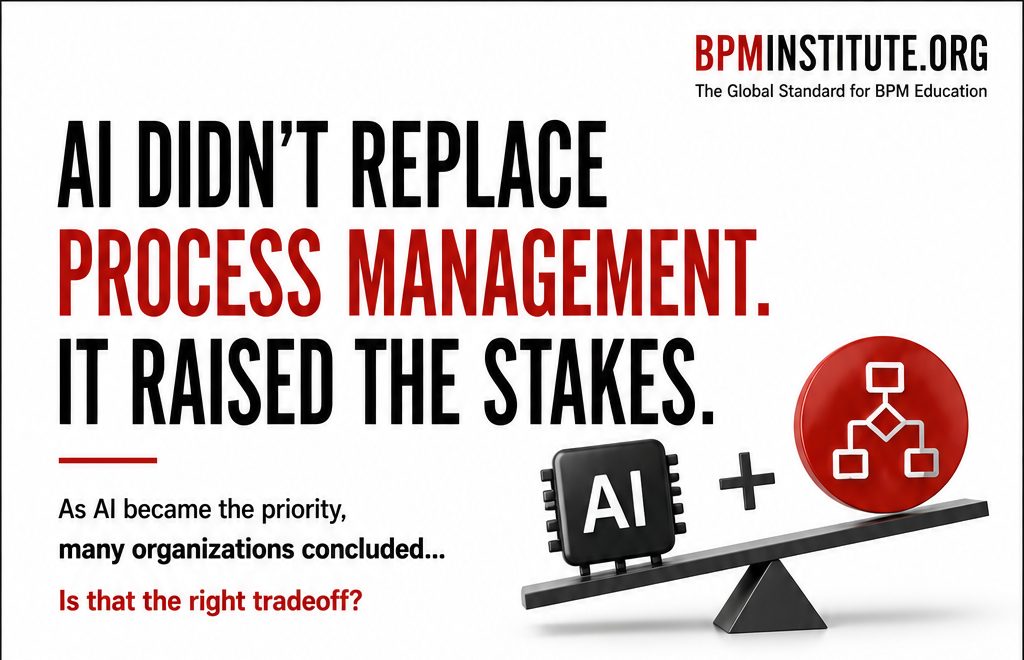
AI does not replace process management. Stronger process capability helps organizations connect AI activity to real business results.
Download the PDF — AI Didn’t Replace Process Management. It Raised the Stakes.
The assumption: AI is the priority, process management can wait
When AI becomes the priority, process management can start to look like something separate.
AI feels urgent. Process work may feel slower, more foundational, or easier to postpone.
But that separation creates risk.
AI does not operate in a vacuum. It is applied inside workflows, decisions, teams, systems, handoffs, approvals, exceptions, customer requests, and business processes that already exist.
If those processes are unclear, inconsistent, or poorly understood, AI may not solve the problem. It may simply interact with the same problems in a faster, more visible, or more automated way.
That is why process management should not be treated as something AI replaces.
It is part of what helps AI become useful in real business work.
The new realization: AI needs stronger process capability
Organizations that are serious about AI need more than tool access.
They need stronger process capability.
Process capability helps teams understand the work before they try to improve it. It gives people a way to identify where delays occur, where ownership is unclear, where decisions slow down, where rework appears, and where outcomes are not matching business expectations.
That matters because business use of AI depends on context.
A team can use AI to summarize information, draft documentation, support analysis, or identify patterns. But the team still needs to understand whether the work being improved is the right work, whether the problem has been defined clearly, and whether the recommendation fits the business situation.
AI can support the work. Process capability helps direct it.
Process capability helps AI succeed in real work
The question is not whether AI or process management should come first.
The stronger question is how they work together.
AI can help teams move faster. Process management helps teams know where faster movement matters.
AI can help generate options. Process management helps teams understand which options fit the current process, the desired outcome, and the people affected by the change.
AI can help organize information. Process management helps teams interpret that information in the context of real work.
That connection helps move AI from isolated activity toward meaningful improvement.
Process management does not guarantee AI success, but it gives organizations a clearer foundation for applying AI to work that matters.
What leaders should look at again
For leaders, the tradeoff is not:
AI or process management?
The better question is:
Are we building the process capability needed to make AI successful?
That means looking at whether teams can clearly explain how work gets done today. It means understanding where work breaks down before applying AI to it. It means connecting AI use cases to outcomes the business can recognize, support, and measure.
It also means making sure process professionals are not left out of the AI conversation.
They bring the understanding needed to connect AI activity to the way work actually happens.
AI raised the stakes for process management
AI did not make process management less relevant.
It raised the stakes.
As organizations introduce AI into more areas of work, the impact of unclear processes, weak ownership, inconsistent decisions, and poor process visibility can become more visible and harder to ignore.
AI may help teams move faster, but speed is not the same as improvement.
Improvement requires direction. It requires understanding. It requires process capability.
Organizations that want AI to produce real business results should give process management a hard look, not because it competes with AI, but because it helps connect AI to value in the real world of work.
BPMInstitute.org helps organizations strengthen the process capability needed to connect AI, work, and business performance. Visit BPMInstitute.org or call (855) 304-8444 to start the conversation.