

Many organizations are moving quickly to give employees access to AI tools.
That access matters. But access alone does not create business value.
Once teams begin using AI, activity can increase quickly. People may use it to summarize information, draft documentation, analyze inputs, generate ideas, support discovery, and accelerate parts of their daily work. For process teams, AI can be useful when it supports the work they already do: understanding how work gets done, where it breaks down, and what should change.
But AI activity is not the same as business improvement.
The value comes when AI is connected to process work: how workflows, where it breaks down, which decisions matter, and what outcomes need to improve.
That is the gap many organizations now need to close.
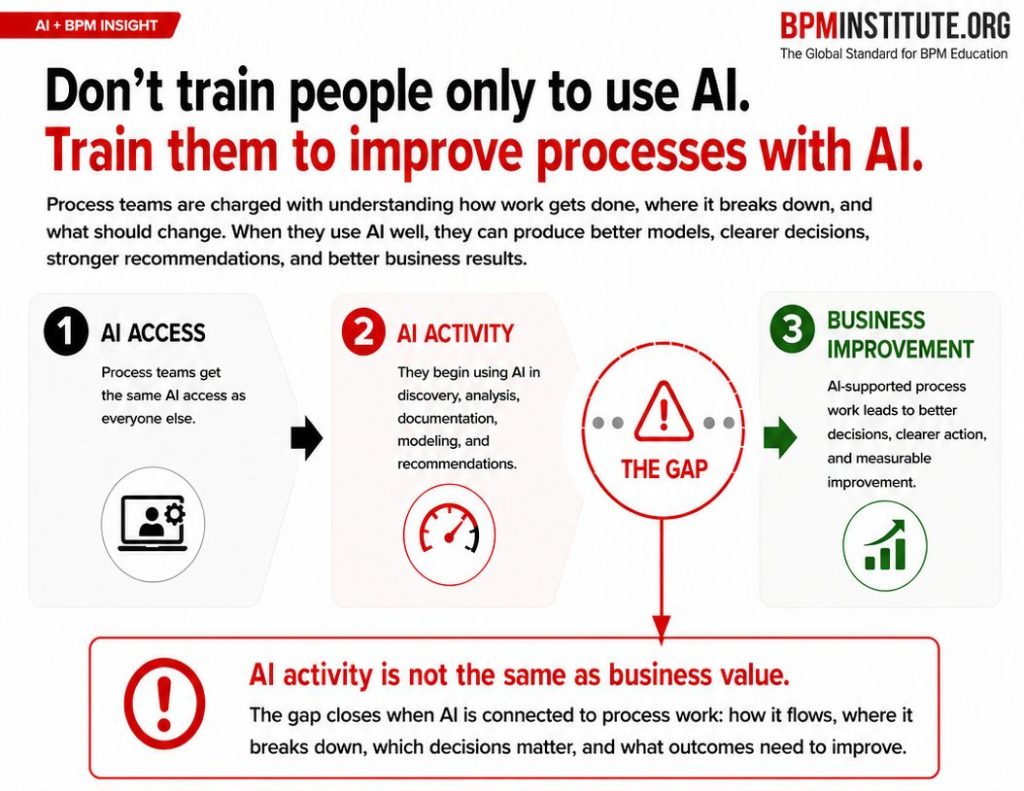
AI activity is not the same as business value. The gap closes when AI is connected to process work, business outcomes, and measurable improvement.
Download the PDF — Turning AI Activity into Process Improvement
AI access is only the starting point
Giving process teams access to AI tools is an important first step.
It allows people to experiment, learn new capabilities, and begin using AI in their work. Teams may start applying AI to discovery, documentation, process analysis, modeling, communication, and recommendations.
But access does not guarantee better outcomes.
A team can have access to AI and still struggle to clarify the real process problem. They can produce more content without improving decisions. They can move faster without reducing rework. They can generate more analysis without creating clearer action.
That is why AI training should not stop at tool usage.
The more important question is whether teams know how to apply AI in ways that improve the work itself.
AI activity can create motion without value
Once people begin using AI, it can feel like progress is happening.
There may be more drafts, more summaries, more diagrams, more meeting notes, more analysis, and more recommendations. That activity can be useful, but it can also create a false sense of advancement.
This is the same risk behind the AI productivity trap: faster output can look like progress even when the team has not moved closer to a clearer decision, stronger recommendation, or better process outcome.
The risk is that teams become better at producing AI-assisted outputs without becoming better at improving processes.
For process professionals, that distinction matters.
A process team is not responsible for using AI just because it is available. The team is responsible for understanding work, identifying gaps, surfacing issues, improving flow, supporting decisions, and helping the business act on what needs to change.
AI can support the work, but process professionals still need to apply judgment, validate outputs, and connect recommendations to the realities of the business.
The gap is between AI use and business improvement
The central gap is not usually whether people can use AI.
The gap is whether they can use AI in a way that improves process outcomes.
That requires process understanding. Teams need to know where the work begins and ends, who is involved, where handoffs occur, where delays happen, what decisions slow progress, which requirements are unclear, and where risks or rework appear.
Without that process view, AI can accelerate the wrong work.
It may help people produce more documentation without clarifying the real issue. It may generate recommendations that are not tied to business priorities. It may support analysis that does not lead to a decision. It may create polished outputs that still leave leaders unclear about what to approve, change, or prioritize.
The gap closes when AI is connected to the process context behind the work.
Where process turns AI activity into business value
AI becomes more valuable when process teams use it with a clear focus on outcomes.
That is where AI-supported work has a better chance of contributing to practical improvement.
Fewer delays
AI can help process teams during discovery and analysis by surfacing issues sooner, organizing inputs, summarizing stakeholder feedback, and helping teams see patterns in how work moves.
When used well, this can help teams identify problems before momentum drains out of an initiative.
The value is not simply that AI may make parts of the work faster. The value is that teams may be able to surface problems earlier, prepare decision-makers more effectively, and reduce time spent circling around issues that should already be visible.
Less rework
Rework often happens when gaps, handoffs, requirements, risks, or decision points are not clear early enough.
AI can help process teams clarify those areas before small misses turn into another round of revision. It can support comparison, synthesis, documentation review, and scenario thinking.
But AI does not eliminate rework on its own.
The team still needs process discipline. They need to know what to look for, what questions to ask, and how to use AI to test whether the process understanding is complete enough to move forward.
Better decisions
Process work often leads to decisions about priorities, tradeoffs, risks, resources, timing, roles, and next steps.
AI can help teams organize analysis in ways that make those decisions clearer. It can help summarize options, compare scenarios, identify implications, and turn process findings into a more useful decision conversation.
But better decisions require more than better information.
They require the right process context. Leaders need to understand what is happening, why it matters, what the options are, what risks are involved, and what action is being recommended.
AI can support that clarity when teams know how to use it for decision support, not just output generation.
Clearer action
One of the most important outcomes of process work is action.
A recommendation should not leave people wondering what happens next. It should help leaders understand the issue, the value of addressing it, the decision required, and the next step.
AI can help process teams strengthen recommendations, clarify rationale, improve communication, and prepare for likely questions.
But again, the value depends on how AI is used.
The goal is not a more polished presentation. The goal is a stronger recommendation, clearer rationale, and a next step leaders can approve.
The executive question
For leaders, the question is not only:
Are our people using AI?
The stronger question is:
Are we training people to improve work with AI?
That difference matters.
Training people only to use AI may increase activity. Training people to improve processes with AI can help connect that activity to clearer decisions, fewer delays, less rework, stronger recommendations, and business improvement the organization can recognize and measure.
Organizations that want real value from AI need more than tool adoption. They need teams that understand how to apply AI to the work that actually drives outcomes.
Start with the gap that matters most
The best place to begin is not with a general AI use case list.
Start with the process gap that matters most.
Where is work slowing down? Where are teams repeating effort? Where are decisions getting stuck? Where are recommendations failing to turn into action? Where is the business asking for improvement but struggling to define what needs to change?
Those are the places where AI can become more than activity.
When process teams apply AI with process understanding and a clear focus on outcomes, they can help the business move from experimentation to measurable improvement.
BPMInstitute.org helps teams build the process skills needed to turn AI activity into business value through practical AI and process training. Schedule a conversation to discuss the process gaps that may be keeping AI adoption from producing real results.