

4 Questions to Ask Before You Decide
Professional development usually does not stall because people stop caring about growth. It stalls because the next step feels unclear.
You may know you want to sharpen your skills, strengthen your credibility, or prepare for bigger responsibilities. But when you are already busy, already experienced, and already weighing competing priorities, earning a professional certificate has to feel like more than “something good to do.”
It has to feel like the right move.
That is where the “worth it” question becomes useful. Not as a reason to hesitate, but as a way to decide with confidence.
Is this certificate aligned with where you want to go next? Will it help you build skills you can actually use? Will it make your experience more visible, credible, and valuable?
If the answer is yes, a professional certificate can do more than add a credential to your profile. It can help you turn professional development into career momentum.
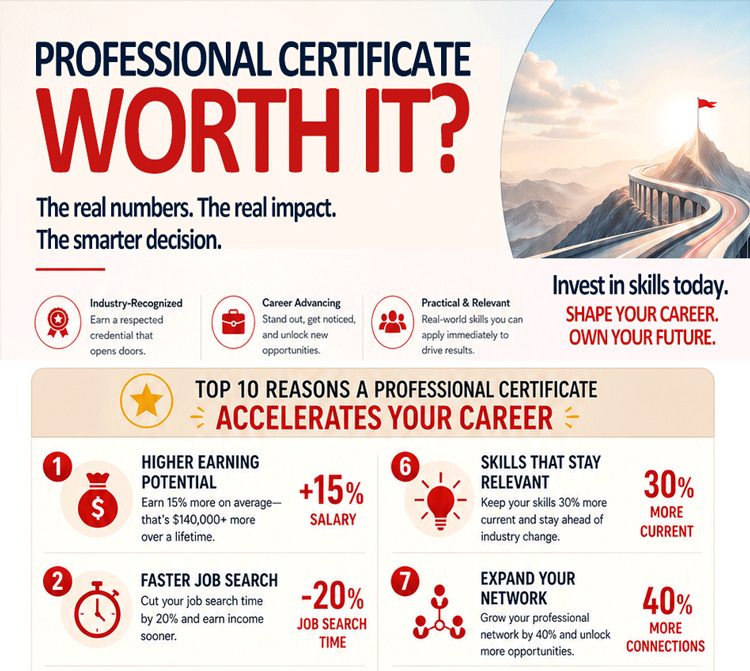
Professional Certificate: Worth It? A quick decision guide for deciding whether a certificate is the right next step for your career.
Is it role-aligned?
The right certificate should connect the professional you are today with the role you are trying to grow into next.
That matters because career growth is not just about learning more. It is about building the capabilities that help you contribute at a higher level. In What Skills are Needed for BPM Success?, Andrew Spanyi points beyond process modeling alone to broader capabilities such as change management, facilitation, customer experience, benchmarking, and governance. Those are the kinds of capabilities that help practitioners move from understanding processes to improving how work actually gets done.
That is a useful way to think about role alignment. If you want to be seen as someone who can improve processes, lead better conversations, support transformation, or connect improvement efforts to measurable outcomes, your learning path should help you build those capabilities deliberately.
A certificate can help when it gives that growth direction. It can help you move from informal experience to a more structured skill set. It can also help you clarify the kind of work you want to be known for, whether that is process improvement, BPM, business architecture, process automation, operational excellence, or transformation.
The question is not simply whether a certificate looks good. The question is whether it helps you close the gap between your current responsibilities and the next level of contribution you want to make.
Is it market-relevant?
A professional certificate should give your learning direction and help you build knowledge you can take pride in. It should also connect that learning to capabilities that matter in the field: skills employers understand, teams need, and practitioners are expected to demonstrate.
In BPM and related disciplines, those capabilities may include process improvement, process modeling, business architecture, decision modeling, automation readiness, transformation, performance improvement, and governance.
As you compare BPM training options, one important credibility point is that BPMInstitute.org has been recognized by Forrester Research as a leader in BPM training and certification, including online and in-person training for BPM professionals. Forrester also cited BPMInstitute.org as a leader in the BPM training market and a top scorer in 7 of the 15 BPM skills development categories. Read more about the findings in Forrester’s The Forrester Wave: BPM Training And Certification Programs.
This is also where the difference between certificates and certification becomes important. In BPM Certification vs. Specialist Certificates: Which One Is Right for You?, Ahmet Akal frames BPM as a broad and evolving discipline with multiple paths for elevating expertise, including certification and specialist certificates in areas such as automation, Lean Six Sigma, or industry-specific frameworks.
That distinction matters for practitioners who are deciding what step to take next. A certification may validate broader mastery. A professional certificate may help you develop a focused capability area, deepen your knowledge, or build momentum toward a larger credential. Both can have value, but they serve different purposes.
For someone who is not ready for a certification exam, or who wants to strengthen a specific skill set first, a professional certificate can be the more practical step.
It gives professional development structure, gives learning a goal, and connects that effort to a recognizable area of expertise.
Market relevance is not about chasing every new trend. It is about choosing a path that matches where your field is going and where your organization needs stronger capability.
Can you apply it?
The value of a certificate is not proven when you earn it. It is proven when your work changes because of it.
That is why practical application matters. A strong certificate should help you return to work with better questions, clearer methods, sharper language, and more confidence in how you contribute. It should help you analyze processes differently, align stakeholders more effectively, identify gaps faster, and connect improvement efforts to outcomes people care about.
For BPM practitioners, application can show up in many ways: mapping a process more clearly, helping stakeholders align around how work actually flows, identifying gaps or inefficiencies, improving handoffs, supporting automation discussions, or translating business needs into better process decisions.
That practical mindset is reinforced in How to Apply BPM Concepts at Work Without a Certification, which makes the point that BPM principles are not reserved only for people with formal credentials. Anyone willing to examine how work really gets done can begin applying BPM concepts in ways that make work — and the organization — more efficient, effective, and agile.
That idea keeps the value of learning grounded in work. The certificate is not the end of the story. The real value comes from what the professional is able to do differently because of the learning.
A useful certificate helps you see your work differently. It helps you ask better questions, recognize patterns, communicate with more confidence, and contribute to outcomes that matter. When that happens, the return is not abstract. It becomes visible in the quality of your decisions, the strength of your recommendations, and the impact you can have on your team or organization.
Is the timing right?
Sometimes the question is not whether you need more skills. It is whether your role is already outgrowing the skills you have been relying on.
That is where timing becomes important. Your organization may be moving toward transformation, automation, operational excellence, AI-enabled work, or more disciplined process management. You may be getting pulled into broader conversations, asked to contribute at a higher level, or expected to connect business needs with better ways of working.
This is especially relevant in process-related fields. In The Role of AI and Automation in BPM (Without the Jargon), Ahmet Akal and Gregg Rock explain how AI and automation are changing the way organizations optimize processes, reduce bottlenecks, improve consistency, and support better decisions. That kind of change raises the bar for professionals who want to stay relevant as process work continues to evolve.
That shift creates pressure, but it also creates opportunity. As organizations rethink how work gets done, professionals who understand processes, decisions, business rules, cases, exceptions, and execution logic become more valuable. They are better prepared to connect improvement efforts with broader business outcomes.
The timing question is not about rushing into a certificate because change is happening. It is about recognizing when your environment is already asking more of you. If the conversations around you are becoming more strategic, more technical, more cross-functional, or more transformation-oriented, then building your skills now may help you participate at a higher level.
When your work is asking more of you, a certificate can help you meet that moment with more confidence and credibility.
Certificate or certification: which comes first?
One source of confusion is the difference between earning a professional certificate and pursuing certification.
A professional certificate typically recognizes completion of a structured learning path. It signals that you have completed focused training in a particular subject area or capability. Certification, by contrast, often validates broader knowledge or professional mastery, usually through an exam or formal assessment.
Neither path is automatically better. The better choice depends on your experience, your goals, and what you are trying to accomplish next.
For some professionals, a certificate is the right first step because it builds confidence and strengthens a focused skill set. For others, certification may be the goal once they have accumulated enough knowledge and experience to validate broader mastery. In many cases, the two can work together: certificates help build capability, while certification validates professional expertise.
That distinction is worth revisiting in BPM Certification vs. Specialist Certificates: Which One Is Right for You?, especially for practitioners who are comparing a specialist certificate path with the broader goal of BPM certification.
So, is a professional certificate worth it?
A professional certificate is worth it when it helps you answer yes to the questions that matter:
Is it aligned with the work you want to do next?
Is it relevant to the market and the skills organizations value?
Can you apply what you learn in meaningful ways?
Is the timing right for your career, your role, and your goals?
When those answers line up, a certificate becomes more than a credential. It becomes a practical way to focus your development, strengthen your credibility, and build confidence for what comes next.
For process professionals, that can be especially powerful. The work is changing. Organizations are asking for better processes, smarter decisions, stronger alignment, and more adaptable ways of operating. Professionals who continue to build relevant, practical skills are better prepared to meet that moment.
The real value of a professional certificate is not simply that you earned it. It is what it helps you do next.
If you are weighing whether a professional certificate is the right move, start with the Learning Paths. They can help you compare available certificate options against the four questions above: role alignment, market relevance, practical application, and timing.