

BPMInstitute.org participated in a Forrester Research report entitled “The Forrester Wave: BPM Training And Certification Programs, Q2 2012.” The report evaluated training and certification programs offered in business process management. BPMInstitute.org made the report available to readers for a limited time, and this article provides additional comments on the topics presented in the Forrester report. You can find the summary of the report here: Independent Research Firm Recognizes BPMInstitute.org as a Leader in BPM Training.
The report’s research findings aligned with our own research into students’ objectives for taking BPM training.
Many companies that attend our training are seeking to transform themselves into process-centric organizations and consider this transformation critical to their future success. These enterprises understand that effectively architecting and managing a process-driven enterprise requires strategic planning of business goals, identification of mission-critical business processes, and specification of desired process improvement outcomes before serious investments in technology are made.
Our research has identified several strategies common to enterprises achieving the greatest return from their BPM initiatives:
- Identify high-value business processes in areas such as compliance and risk management, customer service, and supply chain operations.
- Develop metrics for achieving measurable, quantifiable results through improvements in operational efficiency, process visibility and control, and business agility.
- Establish long-term goals to evolve from process improvement to process excellence.
Our training provides the information and techniques required to help companies implement those strategies.
BPMInstitute.org also found that the Forrester Research regarding the importance of developing T-shaped skills agreed with our own. Forrester defines these as “deep skills in specific process improvement methods and techniques and broad skills across core BPM concepts such as process analysis, process modeling, and process architecture.”
Today, BPMInstitute.org’s catalog has expanded well beyond the program reflected in the Forrester report, while continuing to address both dimensions of BPM skill development: broad understanding across core BPM concepts and deeper applied skills in specific methods, techniques, and practice areas. View the current catalog through our Learning Paths to explore available courses by topic area and professional development goal.
Thinking About a Professional Certificate?
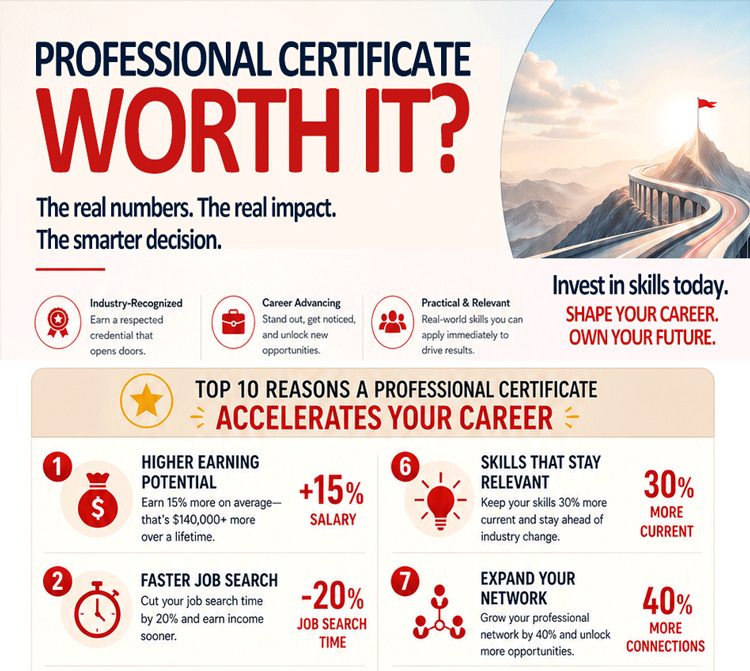
This free decision guide walks through four questions to ask before choosing your next learning path: role alignment, market relevance, practical application, and timing.
Read the Free Guide
We define BPM as a discipline comprised of practice areas and provide a curriculum to teach them:
- Aligning Processes with Business Strategy
- Discovering and Modeling Processes
- Analyzing and Benchmarking Processes
- Harvesting Policies and Rules
- Continually Improving Processes using specific methodologies
- Re-engineering Processes
- Managing Changing of a Culture
- Governance and decision making
- Deploying Technology
There are three important points about a discipline:
- A broad understanding of a discipline is how it is applied to a specific branch of knowledge.
- The definition of a discipline captures the idea of following a pattern of behavior — not specific steps as with a methodology — but the belief that there must exist some form of control, compliance, and order.
- The definition of a discipline complements that of a methodology by stating that a discipline embraces a set of rules or methods.
Our courses provide instruction in both the discipline of process thinking and the methodology for process improvement.
Our training is intended to help companies realize the following promise: BPM represents a natural convergence of methodologies and technologies, providing an architecture that enables faster responses to changes in business strategy. It enables a holistic, 360-degree approach to process collaboration and management throughout the value chain. When properly implemented, it can enable the continuous alignment of processes with business objectives.
BPM is about efficiency: doing more with current investments and economically connecting those investments with the business processes they support. BPM is also about innovation: providing a structured approach to keep the business constantly engaged in an evolutionary process of exploration, experimentation, and education toward business operations excellence.
The Forrester report remains an important point of recognition because it reflects the same foundation that continues to guide BPMInstitute.org’s training today: helping professionals build both the broad process perspective and the applied skills needed to support process-driven business improvement.
Professionals who want a structured path for building BPM capability can explore BPMInstitute.org’s certificate programs, which provide guided coursework across BPM, Business Architecture, Artificial Intelligence, Process Automation, Operational Excellence, Digital Transformation, and related disciplines. Experienced practitioners who want exam-based professional recognition can also learn more about BPM Certification, which is designed to validate competency across the core practice areas of business process management.