

A specialized training request can sound simple at first.
A team needs training. A leader has a goal. A group of employees needs to build skills, align around shared methods, support current process work, or strengthen the way they work.
But for the Talent & Development team behind the request, the work is rarely simple.
The learners may not all have the same background. The business need may still be forming. The schedule may be tight. The group may include different roles, experience levels, locations, priorities, and expectations. And the person asking for training may not know exactly what format, length, or follow-up support will make the engagement successful.
That is why specialized group training should not begin on training day.
It should begin earlier, when the request first lands on your desk.
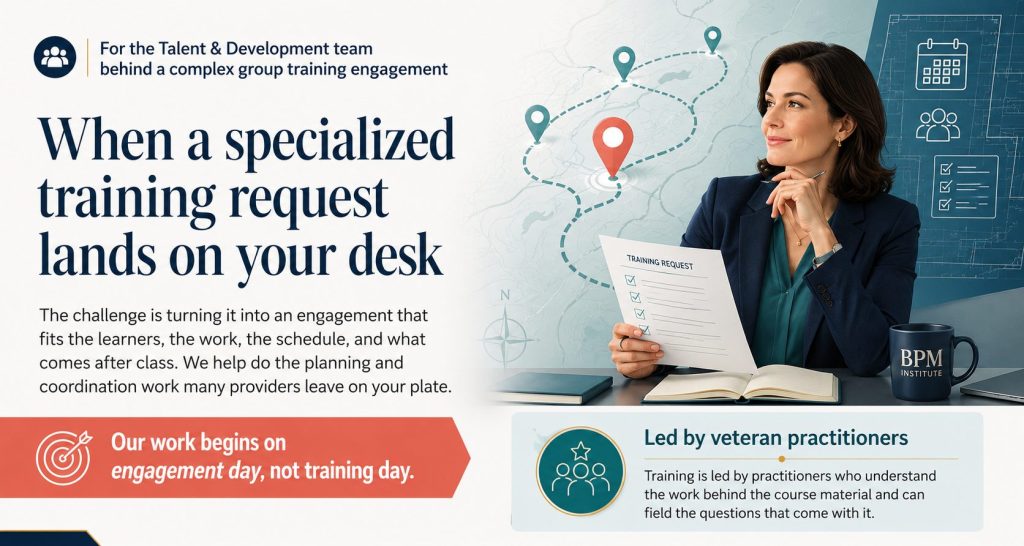
A practical guide for turning a specialized training request into a group training engagement that fits the learners, the work, the schedule, and what comes after class.
Download the PDF – When a Specialized Training Request Lands on Your Desk
A training request is not the same as a training plan
Many group training engagements begin with a broad request:
“We need BPM training.”
“We need process improvement skills.”
“We need our team to understand this better.”
“We need a session for a mixed group.”
“We need training that supports the work we are doing right now.”
Those requests are useful starting points, but they are not yet a complete training plan.
A strong engagement has to answer practical questions before the first session is scheduled. Who is in the group? What do they already know? What are they expected to do differently after training? Is the goal awareness, skill-building, alignment, application, or preparation for a larger initiative? Should the group stay together, or should learners be separated by experience level? What delivery format fits the team’s schedule and work environment?
The earlier those questions are addressed, the more useful the training can become.
Planning is part of the engagement
For complex group training, planning is not administrative cleanup. It is part of the value.
Before training day, the right provider should help shape the learner plan, delivery approach, and support structure. That means understanding the request as it stands, clarifying the business context, and helping the T&D team translate a need into a workable engagement.
That planning may include identifying whether learners should stay together or be grouped by experience level. It may include shaping the format, timing, session length, and schedule. It may include clarifying the process work behind the request, so examples, discussion, and emphasis feel relevant to the participants.
The goal is not to make the T&D team arrive with a perfect plan.
The goal is to bring the request early enough that the plan can be shaped before training begins.
One team may include multiple training levels
A common challenge in group training is that the audience is described as one team, but the learning needs are not identical.
Some participants may be new to the discipline. Others may have years of experience but need a shared language or updated methods. Some may be managers or sponsors. Others may be practitioners expected to apply the material directly.
If everyone receives the same training in the same way, some learners may feel left behind while others feel the material is too basic.
That is why learner planning matters. A self-assessment or planning conversation can help determine whether the group should stay together or be separated by experience level, role, or learning need.
This does not have to make the engagement complicated. It simply helps ensure the training fits the people who will actually be in the room.
The training plan should aim at the real need
A specialized training request usually has a reason behind it.
Maybe the team is supporting a larger initiative. Maybe processes are inconsistent across departments. Maybe people need a shared approach before starting important process work. Maybe a leader sees a capability gap but has not yet translated that gap into a learning path.
A strong training engagement should help uncover that real need.
Before the first session, it is worth asking what the training is expected to support. Is the goal better understanding, better execution, better process conversations, better documentation, stronger analysis, or improved decision-making?
The clearer the need, the easier it is to shape the training around outcomes that matter.
Delivery should fit the group, not the other way around
Specialized training often has to work around real constraints.
Teams may be distributed. Calendars may be difficult. Some groups may need shorter sessions. Others may benefit from deeper workshops. Some engagements may work best live online, onsite, or hybrid delivery. The right format depends on the group, the work, and the business situation behind the request.
Flexibility matters because training that is difficult to attend, difficult to apply, or poorly matched to the team’s schedule can lose momentum before it begins.
The delivery approach should support participation, not create another obstacle.
Training should connect to current or future work
The strongest group training does not feel generic.
Participants should be able to connect the material to the work they are doing now or preparing to support. Examples, discussions, exercises, and emphasis can all help make the training more practical and relevant.
This is especially important for process-related training. Concepts become more valuable when learners can connect them to real handoffs, current challenges, process decisions, improvement opportunities, stakeholder conversations, and the way work actually happens in the organization.
That kind of connection does not happen by accident. It requires planning before training day and instructors who understand the work behind the course material.
Veteran practitioners make a difference
In a specialized engagement, participants often bring real questions into the room.
They may ask how a concept applies to their environment. They may bring up exceptions, constraints, team dynamics, implementation challenges, or scenarios that do not fit neatly into a textbook explanation.
That is where practitioner-led training matters.
Experienced instructors can field questions, respond to scenarios, and connect the material to practical process work. They can help learners understand not just what the concept means, but how it shows up in real organizations.
For T&D teams, this reduces risk. The training does not depend only on slides or curriculum. It is supported by people who can handle the room.
Support should not end after the final session
Training day is important, but it is not the whole engagement.
After the final session, participants may need continued access to LMS materials, free training modules, BPMInstitute.org content, and practitioner guidance that helps them reinforce what they learned.
This matters because group training is often connected to a larger goal. The organization may want better process conversations, stronger internal capability, more consistent methods, or a team that can apply the learning after class.
Follow-up support helps training become more than a completed event.
You do not need the perfect plan before the first conversation
One of the most important things for T&D teams to know is this:
You do not have to finish the training plan before asking for help.
Bring the request as it stands. Bring the audience you think you need to support. Bring the business goal, even if it is still rough. Bring the constraints, the questions, the uncertainty, and the moving parts.
A good planning conversation can help define the training approach, the learner groups, the delivery options, and the next steps.
That is the difference between buying training and building a training engagement.
From training request to training engagement
When a specialized training request lands on your desk, the real job is not simply to find a course.
The job is to turn the request into an engagement that fits the learners, the work, the schedule, and what comes after class.
That requires planning before training day, practical customization during training, and support after the final session. It requires instructors who can handle real questions and connect the material to the process work participants are expected to do.
BPMInstitute.org helps organizations shape group training engagements around real learning needs, delivery constraints, and business context. If you have a specialized training request, start the conversation before the plan is perfect.
Call (855) 304-8444 or contact BPMInstitute.org to discuss your group training needs.