Faculty Member, BPMInstitute.org and CEO and Principal Consultant, Decision Management Solutions
As companies and their software suppliers focus on the processes that control their business, the potential for the “commoditization” of processes is growing. How can companies differentiate themselves, yet still take advantage of the new technologies and approaches in process management?
Let’s start by considering why processes are becoming commoditized.
Business Relationship Manager - Product Lifecycle Management, Chevron Corporation
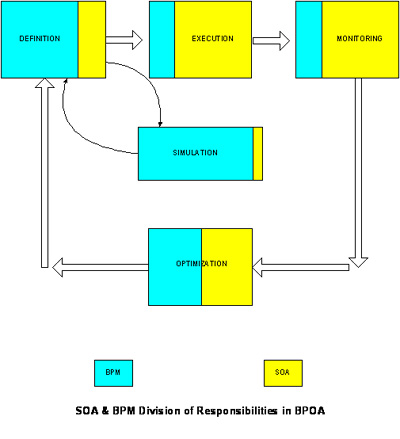
SOA and BPM are two buzzwords you hear or read about in every magazine (well almost all) you open, IT conference you go to, analyst or vendor you talk to. Also, a lot of discussions (or should we say gossip) are focused on the relationship between BPM and SOA. People are curious to know more on their relationship, on how long it would last, etc, the usual stuff you get to hear in the start of any romantic relationship. In order for us to understand the extent of their relationship lets take a closer look at their nature and characteristics and predict if they are meant for each other.
Business Relationship Manager - Product Lifecycle Management, Chevron Corporation
There seem to be two roads to innovation; a high road and a low road, if you like.
The high road is to transform your organization into a learning, nurturing force that uses Systems Thinking to synthesize disparate ideas into what Fritjof Capra calls “emergent forms” – new ways forward that emerge from a primordial sea of barely restrained creativity.
The low road is to follow the example of such Empires as the Mandarin Chinese and Victorian British.
There seem to be two roads to innovation; a high road and a low road, if you like.
To understand the relationship between Business Architecture and SOA, we first need to ask the question what are these two types of architecture? For a description of SOA, see my July SOAInstitute article “Key Components of SOA” at http://www.soainstitute.org/articles/article/article/key-components-of-soa.html. So the next question is “What is Business Architecture”? While there are many available definitions, here are a few that I found useful.
Business Relationship Manager - Product Lifecycle Management, Chevron Corporation
I’ve just finished up four new reports in my 2006 BPMS Report series: Lombardi TeamWorks, BEA AquaLogic BPM, EMC Documentum Process Suite, and Cordys Composite Application Framework.
The BEA report replaces Fuego; the others are new, bringing the total to ten, plus an overview report that explains the common evaluation framework and report format.
Business Relationship Manager - Product Lifecycle Management, Chevron Corporation
Founded in 1643, the State of Rhode Island was the thirteenth colony to ratify the U.S. Constitution. Now known as the “Ocean State,” Rhode Island has approximately one million citizens. With 140 state and quasi-public agencies including 15 to 20 major agencies, the state has approximately 15,000 employees, with 10,000 in the executive branch. The state’s annual budget is around $6.5 billion.
In 2003, the state was running a budget deficit of approximately $180 million.
Business Relationship Manager - Product Lifecycle Management, Chevron Corporation
The Logistics Management Division for NASA includes the Wallops Island Facility, Goddard Space Flight Center, and NASA Headquarters. It has four branches, 50 civilian servants, and 225 contractor personnel. The division has 12,000 Civil Service and contractor personnel. The flight project support operations are ISO 9001 certified, with the processes fully documented. For the institutional support services, the processes are documented in Standard Operating Procedures (SOPs). The goal was to be certified by August, 1999.
Business Relationship Manager - Product Lifecycle Management, Chevron Corporation
The mission for the FBI has evolved dramatically since 9/11. The FBI is transforming its IT systems to support counterterrorism, intelligence, law enforcement, and administrative missions. BPM is vital to the FBI’s continued transformation and evolution and provides the FBI with a cross-functional view of processes.
Business Relationship Manager - Product Lifecycle Management, Chevron Corporation
Web services were created around the notion that it’s easier to discover and leverage somebody else’s service, rather than write your own from scratch. Also, it is much easier to create applications made up of many services, allowing change to occur at a pace faster than anything we’ve seen in the industry thus far.
The idea of Web services was to create a standard interface, programming model, description language, and a directory which would allow this to happen in and between very different systems.
You're looking for a way to improve your process improvement skills, but you're not sure where to start.
Earning your Business Process Management Specialist (BPMS) Certificate will give you the competitive advantage you need in today's world. Our courses help you deliver faster and makes projects easier.
Your skills will include building hierarchical process models, using tools to analyze and assess process performance, defining critical process metrics, using best practice principles to redesign processes, developing process improvement project plans, building a center of excellence, and establishing process governance.
The BPMS Certificate is the perfect way to show employers that you are serious about business process management. With in-depth knowledge of process improvement and management, you'll be able to take your business career to the next level.
Earning your Business Process Management Specialist (BPMS) Certificate will provide you with a distinct competitive advantage in today’s rapidly evolving business landscape. With in-depth knowledge of process improvement and management, you’ll be able to take your business career to the next level.
Earning your Business Process Management Professional (BPMP) Certificate will elevate your expertise and professional standing in the field of business process management. Our BPMP Certificate is a tangible symbol of your achievement, demonstrating your in-depth knowledge of process improvement and management.
Make the most of your hard-earned skills. Earn the respect of your peers and superiors with Business Process Management Certification from the industry's top BPM educational organization.
Earning your Operational Excellence Specialist Certificate will provide you with a distinct advantage in driving organizational excellence and achieving sustainable improvements in performance.
Earn your Operational Excellence Professional Certificate and gain a competitive edge in driving organizational excellence and achieving sustainable improvements in performance.
Earn your Agile BPM Specialist Certificate and gain a competitive edge in driving business process management (BPM) with agile methodologies. You’ll gain a strong understanding of how to apply agile principles and concepts to business process management initiatives.
The Business Architecture Specialist (BAIS) Certificate is proof that you’ve begun your business architecture journey by committing to the industry’s most meaningful and credible business architecture training program.
When you earn your Business Architecture Professional (BAIP) Certificate, you will be able to design and implement a governance structure for your organization, develop and optimize business processes, and manage business information effectively.
Make the most of your hard-earned skills. Earn the respect of your peers and superiors with Business Architecture Certification from the industry's top BPM educational organization.
The Digital Transformation Professional Certificate is the first program in the industry to cover all the key pillars of Digital Transformation holistically with practical recommendations and exercises.
By completing the Process Automation Specialist Certificate, you will not only enhance your modeling skills but also demonstrate a serious commitment to advancing business process management within your organization.