
In a past BR Bulletin, the article “Business Rule Mining: Reasonable or Lunacy” presented how to determine if business rule mining would help your project. Each organization is faced with numerous legacy applications that have become “black boxes.” Business rule mining is a systematic approach of extracting essential intellectual business content (business rules) from packaged or legacy software, recasting them in natural language, and storing them in a source rule repository for further analysis or forward engineering.
Five Principles For BPMS Methodologies
These are exciting times. Business Process Management Suites (BPMSs) are becoming increasingly mature, and we are witnessing the emergence of the BPMS Center of Excellence (CE) in a number of large Fortune 1000 organizations. These are also challenging times. We are bombarded with confusing messages when it comes to the methodologies, tools, and overall culture that need to be developed within an organization to realize the full potential of the BPMS CE.
The Future of BPM
Business Process Management offers the ability to improve business processes significantly..
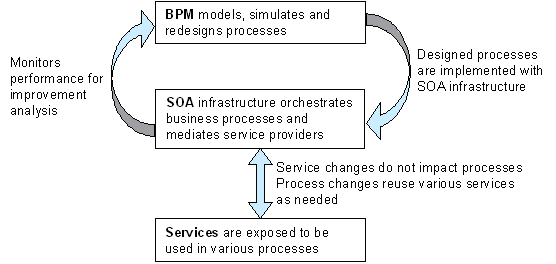
The same technology that supports BPM also can be used to implement composite applications and service-oriented architecture. Vollmer explores these additional capabilities and shows how they are changing the business landscape.
BPEL4People Revisited
The world of BPMS is divided into BPEL-lovers and BPEL-haters, and the thing that BPEL-haters seem to hate most is that even the not-yet-final 2.0 version of the OASIS standard “excludes” human tasks. How can you have a “business process” execution language that cannot accommodate human-performed activities? “Out of scope”?! Are you kidding?
Of course, if you’re a BPEL vendor interested in selling to the BPM market, you have to integrate human tasks somehow, and they all do already. It’s just that they all do it slightly differently.
The world of BPMS is divided into BPEL-lovers and BPEL-haters, and the thing that BPEL-haters seem to hate most is that even the not-yet-final 2.0 version of the OASIS standard “excludes” human tasks. How can you have a “business process” execution language that cannot accommodate human-performed activities? “Out of scope”?! Are you kidding?
Enterprise Business Architecture (EBA) and Service Oriented Architecture (SOA) Initiatives
Most companies today have a strategic initiative focused on Service-Oriented Architecture (SOA) development. Some of these efforts struggled in the early days, but many now have clear goals and measurable objectives. Many of these same companies also have an Enterprise Business Architecture (EBA) initiative as well, or at least some type of Business Process Modeling or Business Process Management initiative. Here again, initially it was a struggle, too.
Successful Process Improvement Requires the Right Mindset
To best take advantage of the power of BPM technology, enterprises first need to achieve a certain aptitude and the right attitude for understanding and improving the firm's large business processes. BPM is not a trendy technical fix for problems. It is a discipline...
SOA Requires Organizational Change
I recently have been working on service-oriented architecture (SOA) models for various clients. Doing this, I have noticed that the models are fairly technical and mostly rudimentary.
Embracing Services: SOA Governance
Organizations are often mystified at how to implement Service Oriented Architecture (SOA). Leaders yearn to sprinkle magic ‘SOA pixie dust’ on their IT organization and transform design and development processes. But holistic architectures are not created by accident. Best practices are forged through the application of engineering discipline and rigor.
Many Global 2000 companies are not ready to embrace services. The design and development teams must first learn how to properly govern their IT processes.
There is an “A” and Silent “M” in SOA
The majority of SOA initiatives that are launched over the next three years will end in disappointment – some initiatives will end in complete failure, while others will simply not deliver the flexibility, reuse and efficiency that SOA promises.
This wont be because of any shortage of cool technology.
New Directions in BPMS Technology
Dr. Bruce Silver defines Business Process Management as a better way to think about the business, seeing across functional and organizational lines. The existing structure of most businesses is a vertical stovepipe arrangement, which goes against this kind of thinking. Great benefits can be achieved from the technology through process automation when BPM is employed, particularly with the human tasks involved. This allows for integration and agility within the enterprise. Another benefit is the ability to monitor the process metrics.