This article originally appeared in the members-only quarterly BPM Strategies Magazine. Join today to receive your own copy.


This article originally appeared in the members-only quarterly BPM Strategies Magazine. Join today to receive your own copy.

Barbara von Halle is the founder of Knowledge Partners, a company leading clients through successful business rules projects through the licensing of KPI STEP, a Business Rule Management Took Kit. Von Halle is a pioneer in Business Rules and received the Outstanding Individual Achievement Award from the International Data Management Association. As a journalist, she wrote for Database Programming and Design Magazine and co-authored several books.

Business architecture is, as my co-chair Ken Orr has said, the “missing link” in the architecture puzzle. While our first architecture conference this past spring focused on Enterprise Architecture, we found a groundswell of support from our attendees and analysts for drilling into the specifics of Business Architecture.
Introduction
SOA projects tend to be large initiatives with a lot of risk and potential reward associated with them. The Return on Investment (ROI) on a SOA project is sometimes very hard to quantify (and thus hard to sell), which brings about the need for a solid process and methodology to ensure the success of an SOA project.
A SOA is a set of tools, technologies, frameworks, and best practices that enable the quick and easy implementation of services.
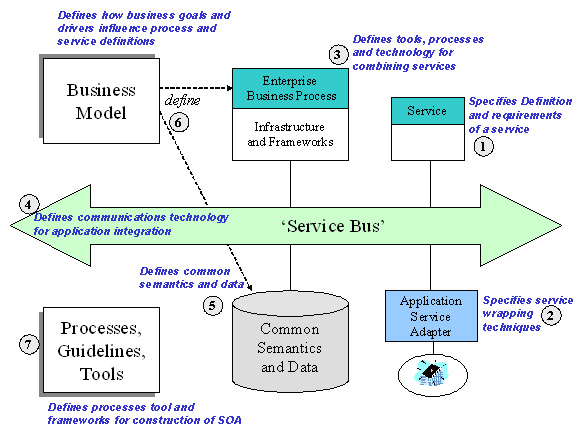
I’m excited to be joining the team of contributors to the SOA Institute. In my first article, I’ll provide my definition of SOA and describe what I think are the key components of an SOA. You will see that I take an enterprise view of SOA.
Vince Sumpter has over 20 years of experience in Performance Management, data warehousing, and related areas and sees a synergy between process management, performance management, and controls transformation. The new regulatory environment demands compliance, but most of the present efforts are manual and specific only to the rules with little regard to how the changes could improve the business. Sumpter sees process, performance, and controls all coming together to give new value to the enterprise.
Sumpter says there is a lot of buzz now about Sarbanes Oxley (S-O).

I recently attended an event where experienced BPM vendors, analysts, academics, and user organizations came to discuss what needs to come next in terms of technical standards, software capabilities, and overall business value from business process technology. The event was hosted by OMG, the standards organization behind the Business Process Modeling Notation standard used for process modeling and, increasingly, for business-driven process design.

It is hard for your organization to have an agile organization these days if your IT systems and infrastructure aren’t. Enterprise Architecture and specifically Business Architecture is aimed at helping organizations become truly agile.
A couple of years ago I wrote an article entitled “The 3 faces of Enterprise Architecture”.
The release of the Academy Award nominations last January might seem to have little to do with business process management. But it does. In many ways, movies are the quintessential process industry.
In the technology world, there is a lot to be said about perception, and how perception defines your reality. You can perceive a market one way, only to change your point of view slightly and realize that the real target market for a class of technologies is quite different from where those technologies are actually being sold. Unfortunately, that change of perception often occurs too late to make a difference. A perfect example of this phenomenon is Enterprise Information Integration, or EII. EII is a specific segment of the data integration market that was gaining some re
Everyone starts here.
You're looking for a way to improve your process improvement skills, but you're not sure where to start.
Earning your Business Process Management Specialist (BPMS) Certificate will give you the competitive advantage you need in today's world. Our courses help you deliver faster and makes projects easier.
Your skills will include building hierarchical process models, using tools to analyze and assess process performance, defining critical process metrics, using best practice principles to redesign processes, developing process improvement project plans, building a center of excellence, and establishing process governance.
The BPMS Certificate is the perfect way to show employers that you are serious about business process management. With in-depth knowledge of process improvement and management, you'll be able to take your business career to the next level.
|
Courses
|
|
|
|
Courses
|
|
|
|
Courses |
|
|
Business Architecture
|
|
|
|
Courses
|
|
|
|
Courses |
Certificate
|
|
Courses |
Certificate
|
|
Courses |
Certificate
|