

A process recommendation can be clear to you and still fail in the room.
That is one of the harder lessons in process work. You may understand the issue. You may have done the analysis. You may know why the recommendation matters and what should happen next.
But the room may not be there yet.
The people listening may not share your context. They may not see the same problem, feel the same urgency, or understand why this recommendation deserves attention now. They may have questions about ownership, timing, effort, priorities, or what happens after the meeting.
That does not mean the recommendation is wrong.
It means the recommendation needs to be ready for the room.
Before you present a process recommendation, take a few minutes to check whether the issue, recommendation, value, likely questions, and required action are clear enough for the audience to follow and act on.
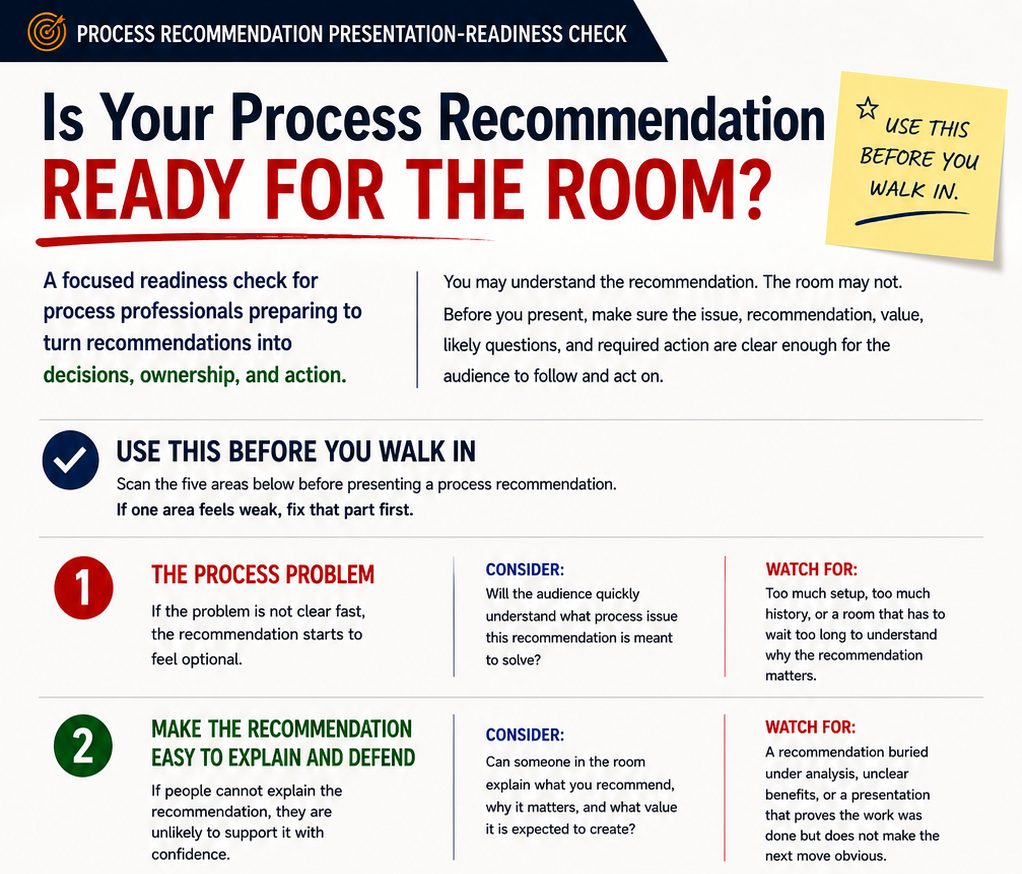
A five-part readiness check for presenting recommendations that decision-makers can understand, support, and act on.
Download the PDF – Process Recommendation: Ready for the Room?
The recommendation is not ready until the problem is clear
Every process recommendation starts with a problem.
But in many presentations, the problem takes too long to appear. The audience hears background, history, analysis, and project context before they understand what process issue the recommendation is meant to solve.
That delay matters.
If the problem is not clear quickly, the recommendation can start to feel optional. The audience may listen politely, but they are still trying to answer a basic question: Why are we talking about this?
A stronger recommendation does not need to include every detail from the analysis. It needs to make the issue clear enough that the audience can understand what is not working, why it matters, and why the current state should not simply continue.
Before you walk in, ask:
Can the audience quickly understand what process issue this recommendation is meant to solve?
Watch for too much setup, too much history, or a presentation that makes the room wait too long to understand why the recommendation matters.
A recommendation should be easy to explain and defend
A process recommendation has to do more than sound reasonable while you are presenting it.
Someone in the room may need to explain it later. They may need to defend it to a manager, sponsor, team, stakeholder group, or decision-maker who was not in the meeting.
If they cannot clearly explain what you recommend, why it matters, and what value it is expected to create, support will be fragile.
That is where many recommendations lose momentum. The work behind the recommendation may include process mapping and process modeling, but the room still needs a clear explanation of what is being recommended and why.
A useful test is simple:
Could someone else in the room explain the recommendation after the meeting?
They do not need to repeat every detail. But they should be able to say what is being recommended, what problem it addresses, why it matters, and what value it should create.
If they cannot, the recommendation may not be ready yet.
The room may not care for the same reason you do
Process professionals often see issues through the work itself: handoffs, delays, rework, unclear roles, confusing steps, weak documentation, poor visibility, or inconsistent execution.
Those things matter.
But the audience may be listening through a different lens. They may be asking: How does this affect my team? What will it require from us? What risk does this reduce? What priority does this support? What decision are we being asked to make?
Process improvement efforts can struggle before they start when the work is not connected to strategic priorities, leadership support, stakeholder readiness, and the people who have to adopt the change.
A recommendation becomes stronger when it connects the process issue to the audience’s stakes.
That does not mean changing the recommendation to tell people what they want to hear. It means translating the process problem into the outcomes, concerns, and decisions the room actually owns.
Before you present, ask:
Have you connected the recommendation to the priorities, concerns, risks, or outcomes this audience cares about most?
Watch for a message that explains the process but misses what decision-makers need to understand, support, or approve.
Predictable questions should not catch you off guard
Most process recommendations create questions.
Who owns this?
How much effort will it take?
What changes for the team?
Why now?
What happens if we wait?
How does this fit with other priorities?
Have we tried something like this before?
Those questions are not a problem. They are part of the decision process.
The problem is being surprised by them.
If a question is obvious enough to predict before the meeting, it should not throw the recommendation off course during the meeting. You do not need a perfect answer to every concern, but you should be ready to discuss the tradeoffs and decision factors that are likely to come up.
Before you present, ask:
What questions, concerns, tradeoffs, or decision factors are likely to surface once the recommendation is discussed?
Watch for recommendations that treat obvious concerns about cost, timing, workload, ownership, risk, competing priorities, or “we tried this before” as surprises.
Agreement is not the same as action
One of the most common traps in process work is mistaking positive reaction for commitment.
A meeting can feel successful because people nodded, agreed with the problem, liked the recommendation, or said the discussion was helpful.
But agreement does not automatically create action.
If the room leaves without a decision, owner, commitment, priority, resource, or next step, the recommendation may still be stuck. Everyone may understand it better, but nothing has moved.
Getting people to understand, support, and follow through on process change requires more than agreement in the meeting. The next step has to be clear enough for people to act on after the discussion ends.
A recommendation should make the needed action clear.
Does the room need to approve something? Assign an owner? Prioritize the work? Commit resources? Bring in another stakeholder? Agree on a next step? Decide between options?
Before you present, ask:
What decision, commitment, owner, resource, priority, or next step does this recommendation need?
Watch for broad agreement without ownership, positive reactions without a clear ask, or a meeting that ends with “this was helpful” instead of “here is what happens next.”
A five-part readiness check before you walk in
Before presenting a process recommendation, scan it across five areas:
1. The process problem
Is the issue clear quickly enough for the audience to understand why the recommendation matters?
2. The recommendation
Can someone else explain what you recommend, why it matters, and what value it is expected to create?
3. The audience stakes
Have you connected the recommendation to the priorities, concerns, risks, or outcomes this audience cares about most?
4. The predictable questions
Have you prepared for the questions and tradeoffs that are likely to come up?
5. The required action
Is the next decision, commitment, owner, priority, or step clear?
If one area feels weak, fix that part before you walk in.
A recommendation does not have to be perfect. But it should be clear enough for the audience to understand, discuss, support, and act on.
Stronger recommendations come from stronger process capability
A good process recommendation is not just a presentation skill. It reflects a broader capability.
It depends on analysis, stakeholder understanding, improvement planning, business communication, and the ability to turn process work into clear, action-ready recommendations.
That capability matters because process professionals are often asked to do more than identify problems. They are asked to help people make better decisions about how work should change.
The stronger those skills become, the more likely a recommendation is to move beyond discussion and become a decision, commitment, and next step.
BPMInstitute.org helps professionals build practical process skills through training and professional certificate programs designed for real process work. Explore Professional Certificates and Learning Paths to find the path that fits your goals.