Business Relationship Manager - Product Lifecycle Management, Chevron Corporation
SOA maturity model is a term that I coined in an attempt to help organizations define architectural guidelines and a process for achieving a greater level of maturity and predictability in their overall information technology (IT) architecture initiatives. The model described in this article is designed to enable your organization to identify itself on a scale of 1 to 5 (with 5 being the most advanced, or mature, level) in terms of architecture maturity.
Business Relationship Manager - Product Lifecycle Management, Chevron Corporation
Unless a company can innovate, it will be left behind in the brave new world of total global competition. But, what exactly is innovation, and how does innovation happen? These are the most important business questions of our times.
Unless a company can innovate, it will be left behind in the brave new world of total global competition. But, what exactly is innovation, and how does innovation happen? These are the most important business questions of our times. Join Peter Fingar for the Inaugural Round Table of our dedicated Innovation “section” on BPMInstitute.org.
Business Relationship Manager - Product Lifecycle Management, Chevron Corporation
Introduction
SOA projects tend to be large initiatives with a lot of risk and potential reward associated with them. The Return on Investment (ROI) on a SOA project is sometimes very hard to quantify (and thus hard to sell), which brings about the need for a solid process and methodology to ensure the success of an SOA project.
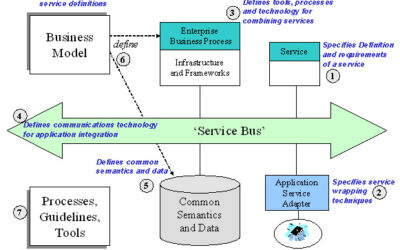
A SOA is a set of tools, technologies, frameworks, and best practices that enable the quick and easy implementation of services.
Business Relationship Manager - Product Lifecycle Management, Chevron Corporation
I’m excited to be joining the team of contributors to the SOA Institute. In my first article, I’ll provide my definition of SOA and describe what I think are the key components of an SOA. You will see that I take an enterprise view of SOA.
Business Relationship Manager - Product Lifecycle Management, Chevron Corporation
Vince Sumpter has over 20 years of experience in Performance Management, data warehousing, and related areas and sees a synergy between process management, performance management, and controls transformation. The new regulatory environment demands compliance, but most of the present efforts are manual and specific only to the rules with little regard to how the changes could improve the business. Sumpter sees process, performance, and controls all coming together to give new value to the enterprise.
Sumpter says there is a lot of buzz now about Sarbanes Oxley (S-O).
Business Relationship Manager - Product Lifecycle Management, Chevron Corporation
I recently attended an event where experienced BPM vendors, analysts, academics, and user organizations came to discuss what needs to come next in terms of technical standards, software capabilities, and overall business value from business process technology. The event was hosted by OMG, the standards organization behind the Business Process Modeling Notation standard used for process modeling and, increasingly, for business-driven process design.
Business Relationship Manager - Product Lifecycle Management, Chevron Corporation
The release of the Academy Award nominations last January might seem to have little to do with business process management. But it does. In many ways, movies are the quintessential process industry.
Business Relationship Manager - Product Lifecycle Management, Chevron Corporation
In the technology world, there is a lot to be said about perception, and how perception defines your reality. You can perceive a market one way, only to change your point of view slightly and realize that the real target market for a class of technologies is quite different from where those technologies are actually being sold. Unfortunately, that change of perception often occurs too late to make a difference. A perfect example of this phenomenon is Enterprise Information Integration, or EII. EII is a specific segment of the data integration market that was gaining some re
Business Relationship Manager - Product Lifecycle Management, Chevron Corporation
Want Examples of Real Results with SOA? Read On.
Adopting a service-oriented architecture (SOA) enables companies to shorten IT project cycles, improve IT agility, and better align their IT practices with overall company strategy while gaining the tactical returns from integration.
Nucleus Research found customers adopting webMethods Fabric
to support an SOA strategy were able to leverage IT alignment and agility to increase market share, build strategic partnerships, increase revenues, and improve customer service.
Business Relationship Manager - Product Lifecycle Management, Chevron Corporation
“Analysis is the difficult part of a business improvement project”. “Analysts are really smart people that are hyper intelligent” and “analysis can not be trained”. Those are some of the preconceptions project teams have to fear the analysis work that needs to be done on a process improvement project.
None of these are true. First of all many people confuse analysis with all those complex statistical tools that, for example, six sigma makes you believe you should apply.
You're looking for a way to improve your process improvement skills, but you're not sure where to start.
Earning your Business Process Management Specialist (BPMS) Certificate will give you the competitive advantage you need in today's world. Our courses help you deliver faster and makes projects easier.
Your skills will include building hierarchical process models, using tools to analyze and assess process performance, defining critical process metrics, using best practice principles to redesign processes, developing process improvement project plans, building a center of excellence, and establishing process governance.
The BPMS Certificate is the perfect way to show employers that you are serious about business process management. With in-depth knowledge of process improvement and management, you'll be able to take your business career to the next level.
Earning your Business Process Management Specialist (BPMS) Certificate will provide you with a distinct competitive advantage in today’s rapidly evolving business landscape. With in-depth knowledge of process improvement and management, you’ll be able to take your business career to the next level.
Earning your Business Process Management Professional (BPMP) Certificate will elevate your expertise and professional standing in the field of business process management. Our BPMP Certificate is a tangible symbol of your achievement, demonstrating your in-depth knowledge of process improvement and management.
Make the most of your hard-earned skills. Earn the respect of your peers and superiors with Business Process Management Certification from the industry's top BPM educational organization.
Earning your Operational Excellence Specialist Certificate will provide you with a distinct advantage in driving organizational excellence and achieving sustainable improvements in performance.
Earn your Operational Excellence Professional Certificate and gain a competitive edge in driving organizational excellence and achieving sustainable improvements in performance.
Earn your Agile BPM Specialist Certificate and gain a competitive edge in driving business process management (BPM) with agile methodologies. You’ll gain a strong understanding of how to apply agile principles and concepts to business process management initiatives.
The Business Architecture Specialist (BAIS) Certificate is proof that you’ve begun your business architecture journey by committing to the industry’s most meaningful and credible business architecture training program.
When you earn your Business Architecture Professional (BAIP) Certificate, you will be able to design and implement a governance structure for your organization, develop and optimize business processes, and manage business information effectively.
Make the most of your hard-earned skills. Earn the respect of your peers and superiors with Business Architecture Certification from the industry's top BPM educational organization.
The Digital Transformation Professional Certificate is the first program in the industry to cover all the key pillars of Digital Transformation holistically with practical recommendations and exercises.
By completing the Process Automation Specialist Certificate, you will not only enhance your modeling skills but also demonstrate a serious commitment to advancing business process management within your organization.